Project Finance Model Assumptions: How to Build Realistic Inputs and Drivers
Introduction to Project Finance Model Assumptions How to Build Realistic Inputs and Drivers
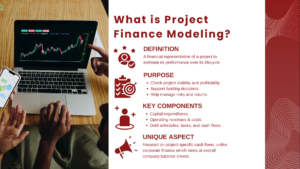
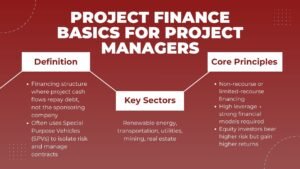
Project finance is important in financing major infrastructural projects like power plants, toll roads, airports and renewable energy projects. The core of any successful project finance transaction is an expertly crafted financial model–an analytical instrument that projects how the project will generate cash and assess the project risk as well as the viability of the project. Nevertheless, the most advanced models are as good as their assumptions are. Realistic or unrealistic inputs are also able to cause distortions in the result, which can in turn result in poor investment decisions. That is why knowing how to make sound, data-supported assumptions is one of the most useful skills in finance professionals, which are involved in infrastructure and project development. Professionals can gain this expertise through a project finance model course Singapore. Drawing on the importance of identifying, justifying, and testing the assumptions underlying a project finance model, this article explains the ways to make sure that forecasts are consistent with project dynamics and stakeholder expectations in reality.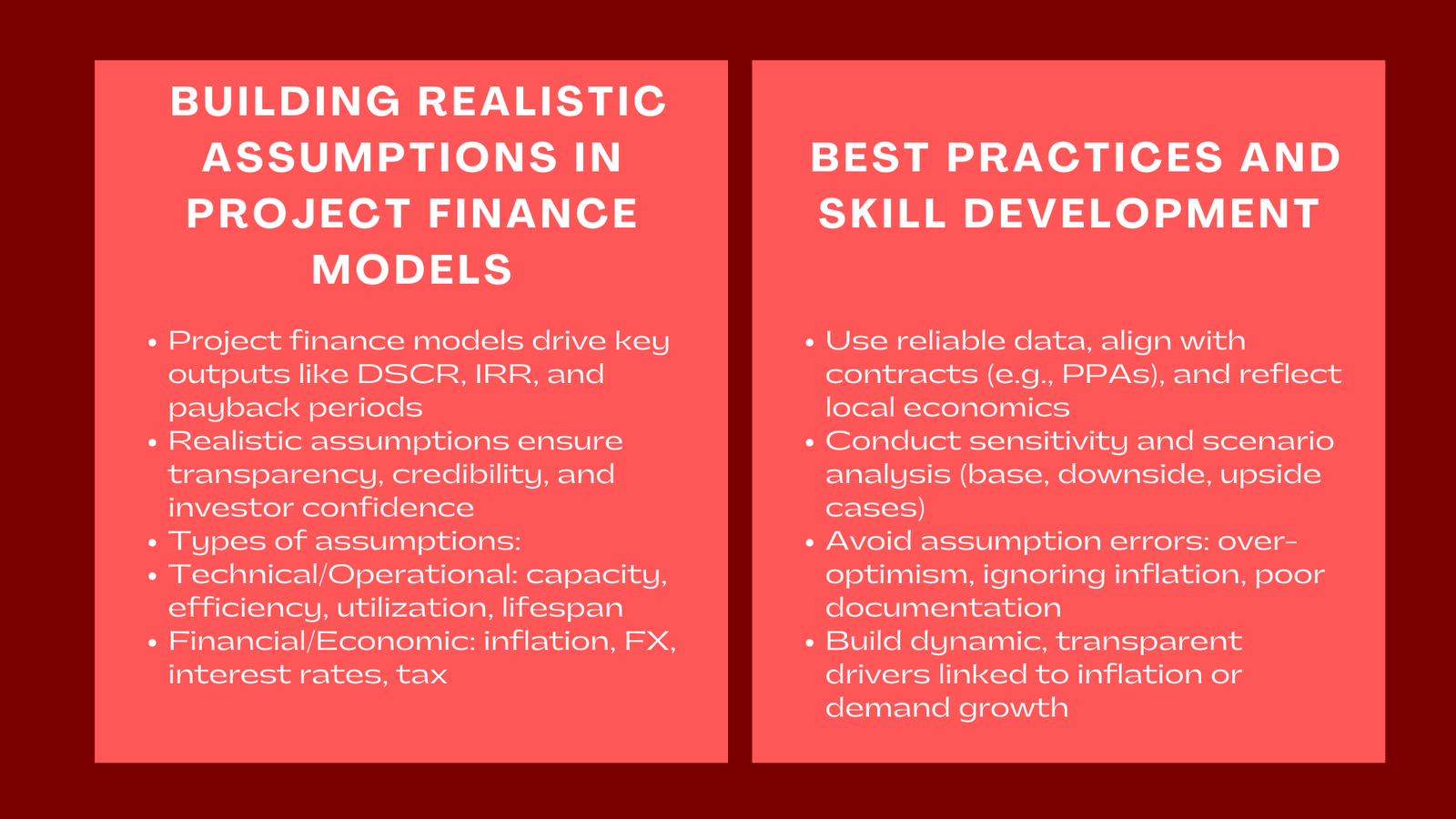
Realistic Assumptions in Project Finance.
Financial models are not forecasts, these are organised depictions of potential results on a foundation of suppositions. These assumptions are the motivating forces of important outputs in project finance, including debt service coverage ratios (DSCR), internally generated rates of return (IRR) and equity payback periods. Since infrastructural projects are normally over a span of decades, even minor miscalculations in assumptions can multiply. Underestimation of expenses and overestimation of revenue can lead to financial strain, breach of covenant or even project failure. The transparency, credibility and investor confidence, therefore, are based on realistic assumptions. They are important to lenders and sponsors to evaluate the risk of projects, negotiate terms of financing and develop mitigation plans.Classes of Assumptions in Project Finance Models.
Project finance models are not finite in their inputs (they could contain hundreds), but they can be grouped into several main categories:Technical Assumptions and Operational Assumptions.
These include project-related information including capacity, efficiency rates, utilization levels and operating life. An example would be that the model of a solar project would contain the degradation of the efficiency of the panels when a toll road project would take as the base assumptions the growth rates of the traffic.Financial and Economic Assumption.
This category comprises of inflation rates, exchange rates, interest rates and tax policies. They mirror the macroeconomic environment in which the project is to be operated.Revenue and Cost Assumptions.
The assumptions about revenue are linked with the forecasts of demand, price formation, and the provisions of a contract (e.g., Power Purchase Agreements). The capital expenditure (CAPEX), operational expenditure (OPEX), and maintenance schedules are considered the cost assumptions.Financing and Debt Assumptions.
These characterize the financing of the project- debt equity ratios, debt term, interest rate, grace period and repayment, profiles. These inputs combined with each other influence the financial structure and define a bankable project.Developing Realistic Inputs and Drivers.
Use Reliable Data Sources
Begin with verifiable information of feasibility tests, market researches, engineering reports and industry standards. On small projects, make conservative estimates and keep a record of the source and reason of all assumptions.Correlate Assumptions and Contractual Terms.
A model should be based on the reality of project contract structures. To take an example, when a Power Purchase Agreement (PPA) has a set of fixed tariffs with an escalation rate every year, the model must reflect that trend accurately.Uses Reflector Local Economic Conditions.
Geography may differ greatly on inflation, currency volatility and tax regime. The introduction of local economic indicators makes the model relevant to the environment in which it will operate.Sensitivity Analysis Assumptions Tests
Even the well-grounded assumptions may evolve. Sensitivity analysis enables the analyst to quantify the impact of critical variables like the interest rates or the demand on the viability of the project. This is done to determine areas where the stress level may occur and aid in risk mitigation practices.Top Ten Model Assumption errors.
Even an established analyst is also subject to error in formulating assumptions. Common pitfalls include:- Over-optimistic projections: i.e. when we assume a very rampant growth or a high efficiency in the absence of evidence.
- Disregard of inflation or currency risk: It results in low costs or inflated revenues.
- Lack of clarity in documentation: It makes it not easy to trace where the assumptions were obtained by auditors or investors.
- Combining nominal and real values: Introducing discrepancies in the forecasts of the cash flows.
Developing Dynamic and transparent Drivers.
A professional model is not based on fixed numbers- it applies dynamic drivers which would automatically adjust in case of a change in the underlying assumptions. As an example, associating OPEX with inflation or relating growth of revenue with anticipated demand enables the models to be flexible as circumstances change. Transparency is also a key principle: the assumption must be labelled, referenced and readable by the stakeholders. Best practices include:- Having a special sheet of Assumptions in the model.
- Having color codes and easy labels of input cells.
- Adding Audit trails by giving version control and update notes.
The Use of Scenario Analysis in Assumption Testing.
Scenario analysis allows the involved parties to learn the interaction between altered assumptions and how they influence the outcomes of the project. For example:- Base Case: This is the real scenario which is expected or most probable.
- Downside Case: Revenue becomes lower, or cost, is increased or delayed due to tests.
- Upside Case: Generates an improved performance.
Developing Expertise Through Training
Professionals seeking to strengthen their modeling capabilities can benefit from structured learning programs like project finance modeling and assumption-building workshops for infrastructure professionals. Through these technical courses, the participants learn how to design, audit and optimize the financial models applied in high-scale projects. Participants learn to:- Logical and consistent structure assumptions.
- Building schedules, revenue plots and operation cost.
- Include inflation, tax and foreign exchange effects.
- Make sensitivity and scenario analysis work.
- Make financial modeling meet lending and sponsoring demands.
Relationship between Risk Management and Assumptions.
Risk allocation is impossible without project finance models. Analysts can model the risks of a contract that include construction delays, cost overruns, or interest rate increases by changing assumptions. As an illustration, lenders tend to put their project through test scenarios of whether the DSCR is above the required level. These insights are used by sponsors to develop contingency plans or renegotiate some main terms prior to financial close. By so doing, assumptions serve as the cornerstone of the model as well as the means of determining financial resilience.Using Technology to manage Assumptions.
Financial models have developed beyond spreadsheets in the modern world. Enhanced software and data integration applications have enabled automatic assumption updates and has increased accuracy and speed. Teams managing complex infrastructure portfolios can benefit from automated project finance model input systems for investment teams, which synchronize live data feeds—such as commodity prices, inflation indices, and interest rate benchmarks—directly into models. This automation minimizes errors in manuals, maintains consistency of data and promotes real time decision making among various projects.Best Practices in Construction of Credible Models.
To make sure that project finance model can stand the test of time, the following best practices should be followed:- Record all acting assumptions: Include source, reason and date of last update.
- Collecting assumptions against industry standards: compare assumptions to other peer projects.
- Be consistent: Have a congruence among technical, financial and contractual data.
- Recurring: Reflect new data on the market or project milestones.
- Ensuring visibility: Easy version control and auditing.