Project Financial Modeling Guide
Introduction to Project Financial Modeling Guide
Project finance Financial modeling has become a vital skill among the financial practitioners, lenders, sponsors, and policymakers, especially in a period when infrastructure development is capital intensive and long term investment planning is taking center stage. Also, unlike the traditional corporate finance, project finance assumes more emphasis to the structured projections of the cash flows than the balance sheet strength in the efforts of risk assignment. Consequently, costly financial modeling is needed to consider viability, bankability, and long term sustainability.
When a project finance model is constructed properly, stakeholders would be able to know how value will be created and how risks would be distributed and the manner in which the financial obligations would be serviced during the project lifecycle. In order to do this, professionals should not just be theoretically educated but have the knowledge of the structure of project finance models and the practice of project finance models in real life conditions. This article explores these three dimensions in order to offer an encompassing information to the analysts, managers, and decision-makers.
Learning about Financial Modeling in Project Finance.
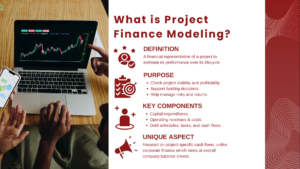
Financial modeling in project finance is the process of creating an elaborate financial expression of a standalone project which is commonly funded by a special purpose vehicle (SPV). It is a model that predicts the cash flow throughout the life of the project, which on average is between 20 and 30 years and determines whether the project can fulfill its financial obligations or not under a number of assumptions.
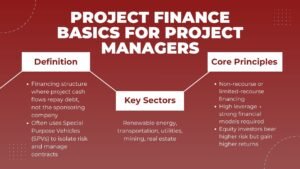
As opposed to corporate financial models, project finance models are very sensitive to contractual agreements including power purchase agreements, concession contracts and offtake agreements. As such, project finance financial modeling requires that legal, technical and operational inputs are combined in one analysis model. It is this complexity that makes project finance modeling such a challenge and necessity, an indispensable element in an interdisciplinary setting.
The fundamental question that the model will address is: Is the project financially viable? Can it service its debt? So, how much will equity investors get? Through solving these problems, project financing financial modeling helps in investment decision-making, credit approvals and risk management initiatives.
Strategic Importance of Project Finance Models
Financial modeling in project finance has a strategic value in that it measures the assumptions into financial results. Project finance models are used by governments to analyze the public- private partnerships, and to analyze credit risk by banks. These models are used to maximize the capital structure by sponsors and developers and to increase equity returns.
A good model will be transparent and disciplined because it will compel the stakeholders to clearly establish assumptions concerning demand, pricing, operating cost, and terms of financing. Financial modeling in project finance through scenario and sensitivity analysis helps decision-makers to evaluate downside risks and resilience during stressful periods.
With a rise in the number of enterprises that are investing in infrastructure, renewable energy and transportation globally, there is a growing demand in the expertise in the financial modeling in project finance.
Core Components of Project Finance Model Structure
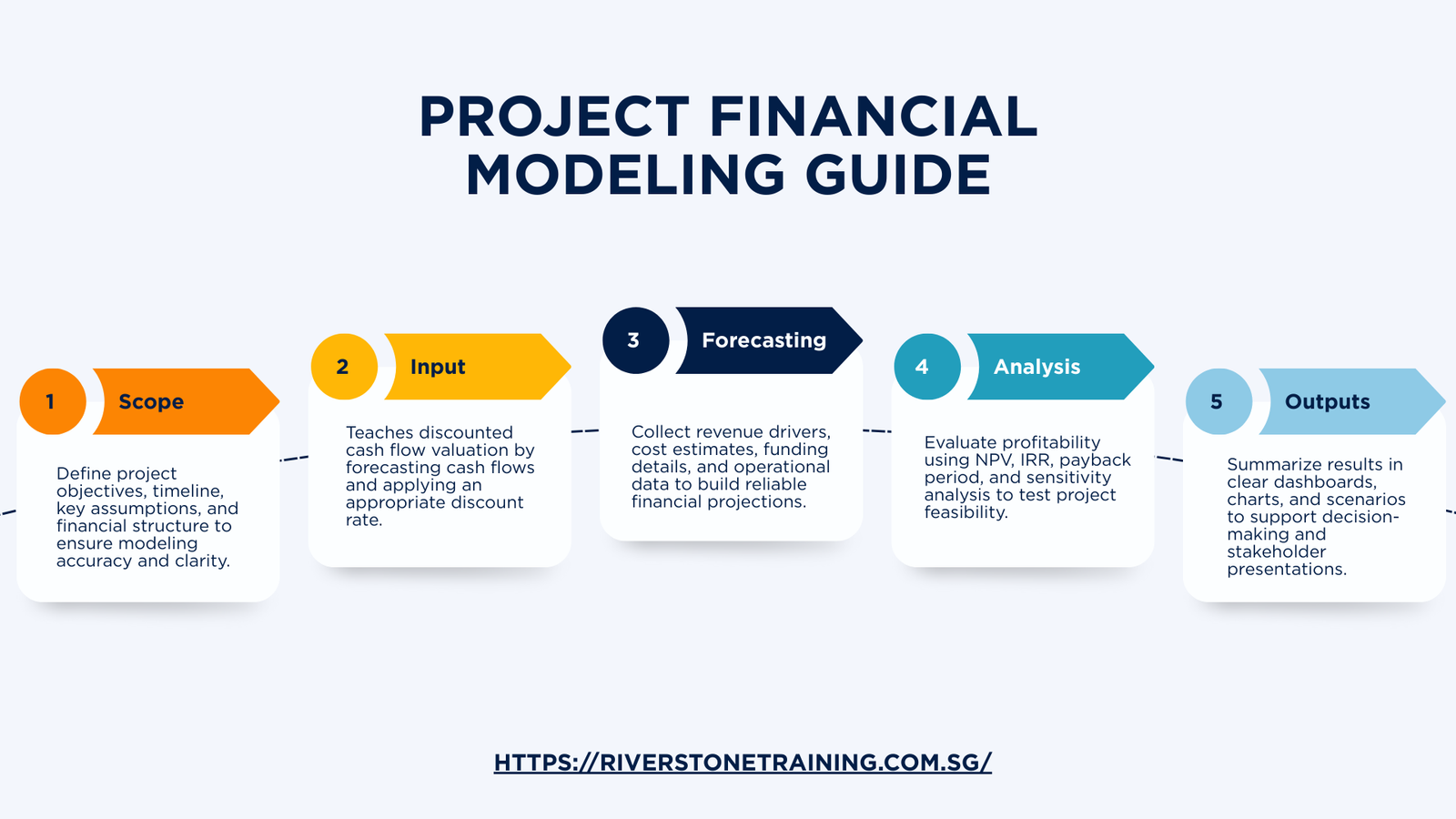
An effective model structure must be used in a project finance to ensure accuracy, transparency and usability. The majority of models contain a logical flow, which is in the form of assumptions and inputs, calculations and finally gives outputs and financial measures.
There is a strong project finance model structure where the input sheets, calculation modules and summary outputs have been clearly separated. It usually takes in inputs and these are capital expenditure, operating costs, revenue assumptions, financing terms and tax parameters. These are the inputs that are used to create integrated financial statements created in calculation sheets.
Close interconnection between cash flow generation and debt servicing is the prominent characteristic of the project finance model structure. In a transparent and disciplined model design, key metrics including cash flow available to service debt (CFADS), debt service coverage ratios (DSCR), and loan life coverage ratios (LLCR) are relied on.
Integration of Financial Statements
Integration of financial statements is another important thing that needs to be addressed in terms of project finance model structure. The income statement is an aspect which shows the performance of operations and the cash flow shows the actual liquidity which can be effectively used to pay off debt and distribute equity. Balance sheet provides consistency in the accounting by monitoring the reserves, debt balances as well as equity contributions.
In the project finance financial modeling, a cash flow statement is commonly the central theme because accountants focus on financial profits instead of predictable and adequate cash flows, which matter more to the lenders. The three statements are dynamically connected in a well-built model that helps to enforce analytical integrity.
Debt and Equity Modeling Consideration
In project finance, debt modeling forms the basis financial modeling in project finance. The model should be able to indicate a precise reflection of the drawdown schedules, interest computation, repayment schedules, and covenant testing. Project finance models that are advanced would typically have sculpted debt repayment relating to expected cash flows.
Although the use of equity modeling is secondary as regards to risk, it is critical to the sponsors. Projected cash flows of equity give metrics like internal rate of return (IRR) and net present value (NPV). The structure of project finance model will ensure that equity distribution takes place after all the debt service and reserve requirements are met.
Project Finance Model Practice in Professional Environments
Although theory gives the basic, practice of project finance model ascertains effectiveness in the real world. As a matter of fact, models change during the development, financing, constructing and operation processes and thus they need to be constantly updated as new information appears.
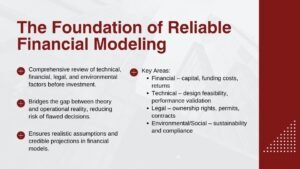
Proper project finance model practice focuses on transparency, written records, and auditing. The assumptions should be stated clearly, the formulae should be traceable to and the outputs should be readable by the third parties like lenders and auditors. Even in cases where the economics of projects make sense, poor modeling discipline is capable of weakening credibility.
Another important element of project finance model practice is version control, which is especially important when there are several stakeholders sharing models. Unmanaged changes may bring error with a serious financial and reputational impact.
Scenario and Sensitivity Analysis
Project finance Scenario analysis and sensitivity analysis are some of the most useful applications of financial modeling. These methods determine the impact of variation of key variables, including the interest rates, the cost of operation, or demand on the viability of the project.
The project finance model practice emphasizes downside scenarios more, which is a risk-averse view of lenders. Stress testing is used to determine break-even and facilitates risk-allocation, guarantees and contingency-reserves negotiations.
The integration of structured sensitivity analysis into the structure of project finance model turns the model into an effective decision support tool, as opposed to a rigid forecast.
Typical Project Finance Modeling issues
Although it is significant, financial modeling in project finance is fraught with a number of challenges. The project tenors are also long which makes assumptions more challenging to confirm. The projections can be seriously impacted by changes in regulations, technological transformation, and macroeconomic fluctuation.
A different issue is a tradeoff between complexity and usability. A highly complicated structure of project finance model can be analytically, but impractically, sound and oversimplified models might not be capable of reflecting important risks. The practice of sound project finance model involves professional judgment to identify the level of detail to be used.
The possibility of human errors is always present, which indicates the necessity of model reviews and independent audits.
Skills Required for Project Finance Modeling
The technical, analytical, and commercial skills are all needed in project finance to master financial modeling. Professionals have to grasp accounting and financial principles as well as evaluate risk and communicate the insights and understanding of the contracts.
The skills in the use of spreadsheets are crucial, yet the use of tools is not enough. A good project finance model practice requires a systematic mind, eye to detail and strict documentation. These skills are what can be attributed to competent modelers as opposed to exceptional modelers as projects become more complex.
The Future of Project Finance Modeling
Technological development, regulatory development, and changing focus on investment will define the future of financial modeling in project finance. Efficiency is being enhanced by automation and sophisticated analytics, and sustainability is becoming a more important factor in assumptions and assessment standards.
However, the basics of project finance model structure such as transparent cash flow analysis, discipline in debt modeling and sound sensitivity testing will not be compromised. Similarly, a good project finance model practice will be dependent on professional judgment, but not solely on automation.
Conclusion
In short, GMF in project finance is one of the foundations of the contemporary infrastructure and long-term investment decisions. Project finance models allow the stakeholders to evaluate the viability of a project, risk management and efficient allocation of capital by transforming intricate contractual and operational suppositions into organized monetary estimations.
Tight project finance model structure facilitates transparency, accuracy, and consistency, whereas the project finance model practice is good at serving the gap between theory and practice. These elements, in combination with one another, make up an overall framework that facilitates sustainable and bankable projects.
With the expansion of project-based financing across the world, project finance modelling construction, interpretation and application will continue to be a very essential professional skill.