Modeling Refinancing and Debt Restructuring in Project Finance
Introduction to Modeling Refinancing and Debt Restructuring in Project Finance
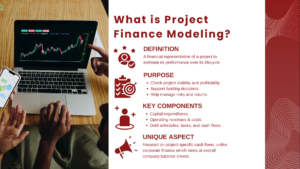
Project finance transactions require refinancing and debt restructuring which is an important element in the life cycle. They are not the technical-financial adjustments; rather, these are the tools of strategy which affect the viability of projects in the long term, efficiency of capital and returns to investors. In big infrastructural, energy and transport projects, typically with the term of interest of 15 to 25 years, market conditions, fluctuations in interest rates and functioning constraints change over time. This, therefore, implies that the debt structure developed on financial close may no longer be optimal and sustainable.
An effective modeling refinancing and debt restructuring in project finance Singapore should therefore be able to cater to the refinancing or restructuring option. Regardless of whether it is made under the impulse of credit quality improvement following successful activities or because of financial strain necessitating the covenant renegotiation, such changes govern how cash flows would be distributed in future between the lenders and equity holders.
In this article, the refinancing and debt restructuring processes are discussed in the context of project finances modeling. It considers underlying conceptual underpinnings, logic behind their core models, analysis and strategy underlying such financial transformations. Through the knowledge of such elements, modelers and decision-makers will be guaranteed that their refinancing organisms promote the value of projects other than jeopardizing them.
Understanding Refinancing and Debt Restructuring
Conceptual Definition and Purpose
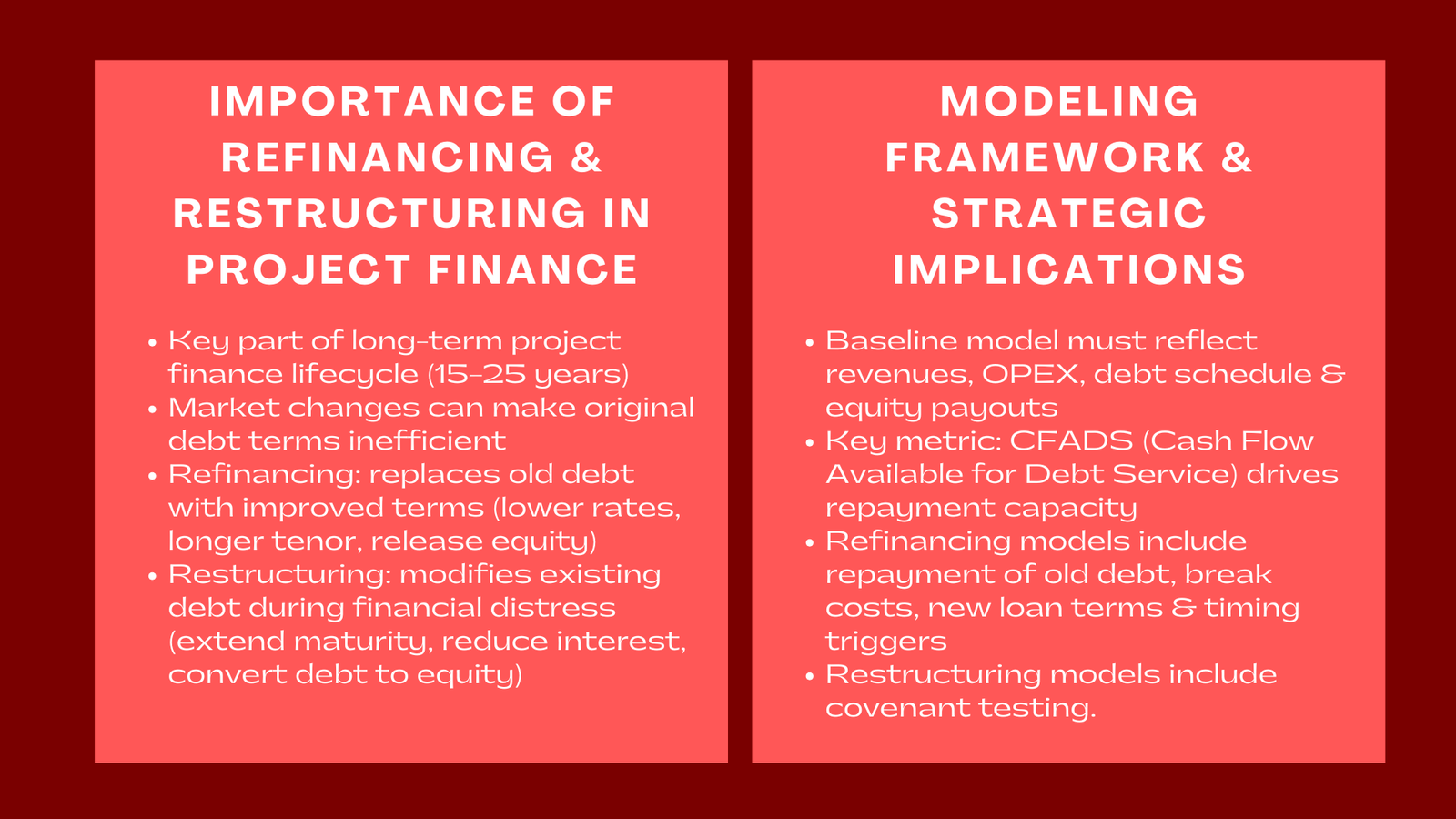
Refinancing means a replacement of current debt with new one governed by new terms – usually an attempt to take advantage of favorable financing opportunities, a lower interest rate or a longer maturity period. It is normally performed when a project finance refinancing and debt restructuring models Singapore has been constructed and is stable in its operation and therefore perceived risk is minimized thereby lowering the costs of borrowing. New capital requirements can also be met by refinancing away equity to sponsors or adjusting financing to new capital needs.
Debt restructuring on the other hand, is a corrective measure which modulates the conditions of an existing debt to remedy a situation of financial distress or covenant breach. It is either doing the maturities lengthening, lowering the margin of interest, repricing of the base payments or making a portion of the debt equity in the form of equity. Whereas the refinancing is opportunity based and proactive, restructuring is typically reactive in nature that seeks to restore the solvency and eliminate default.
The two processes demand stringent modeling to analyze the financial and operational implication of the processes. The quality and adaptability of the model have a direct impact on the outcome of a negotiation process with the lenders, investors and regulators.
Economic Rationale
The reason why refinancing is done is to achieve financial efficiency. The better a project is the lower the risk profile and the more an improved position the lenders have to give favourable conditions. The weighted average cost of capital (WACC) can then be reduced through refinancing which is beneficial to the project net present value (NPV) and internal rate of return (IRR). Conversely restructuring is an attempt to retain the value through the reduction of possible losses and thus the debt service is sustainable.
When such adjustments are properly modeled the sponsors are able to decide whether refinancing or restructuring will value creating or merely shift risk. It also gives lenders clear impressions regarding the ability of the project to face new financing designs.
Modeling Framework and Key Components
Establishing the Baseline Structure
The good basis model has to be available before modeling, refinancing or restructuring can take place. The underlying framework must reflect the revenues of the project, operating cost, and debts schedule as well as equity distributions. This framework is then further developed by the refinancing or restructuring module which on the necessary basis makes adjustments in the cash flow allocations and loan parameters, a core concept often covered in a project finance modelling course Singapore.
The main activity of this modeling technique is the Cash Flow Available to Debt Service (CFADS) the main measure of a project repayment. With the new structure, CFADS will have to feed into the rescalculated debt service ratio and coverage ratio. In the absence of a strong foundation, any further improvements would not be reliable and analytical.
Introducing Refinancing Logic
Refinancing is normally added to a model at a specified date – also known as the refinancing date – at a particular time. It has to clear the balance left on the current loan including the prepayment charges or break cost prior to the introduction of the new facility.
The new debt structure can have varying interest rates, tenors, grace periods or repayment structures. It can as well come with new charges or reserve accounts or revision of security arrangements. The model must take care to make sure that all related cash inflows and outflows take place in the right time and that the ensuing effect to the equity returns, lender IRR and the DSCR is appropriately recorded.
An automatically activated switch-based mechanism – including a flag that is called a Refinancing Year – can be programmed to bring the new debt tranche into play. Flexibility is offered by this approach and it enables the user to dynamically test various refinancing scenarios.
Modeling Debt Restructuring Adjustments
There is a need to think more logically in restructuring scenarios. The model should be able to support any of the following variance that includes deferred principal payments, capitalization of interest or even forging part of the debt capital. Where lenders agree to cut down margins or to convert debt into equity, the effect has to be channeled on the three financial statements: income balance sheet and cash flow statements.
The most important element of restructuring modelling is compliance testing of covenants. The model will have to reveal the way through which the amended form will bring DSCR and the loan life coverage ratio (LLCR) to acceptable levels. Besides, the restructuring can be accompanied by accounting changes, i.e. the recognition of gain or loss due to change, which should have correct accounting effects in the income statement.
Analytical and Technical Considerations
Interest Rate and Credit Assumptions
Repricing of outstanding finance decisions are usually influenced by the fluctuation in interest rates or credit spreads in the market. It then follows that the new credit environment requires that the model include assumptions of benchmark rates (e.g. SOFR or EURIBOR) and new marginal assumptions to reflect the new credit environment. These parameters can be subject to the sensitivity analysis to understand the extent to which the value can be destroyed by the variation in the rates without value being generated as a result of refinancing.
In the case of restructuring, the model ought to consider the different options of interest rates relief to determine their effect on cash flow stabilization. The use of scenario-based testing would offer a quantitative basis on the bargaining between borrowers and lenders.
Treatment of Transaction Costs
Refinancing has transaction costs including arrangement fee, advisory fee, legal fees, and spots repayment fee, whereas restructuring has cost of legal fees and advisory fees. These expenses must be clearly represented either as lump sums or as one time expenses. In case they are funded by new debt, the model would put those drawdown schedules and amortization under adjustment. The neglected transaction costs are resulting in overrewarding benefits and reporting false returns.
Recalculating Key Ratios and Returns
The model has to re-calculate fundamental financial indicators after the refinancing or restructuring. These are project IRR, equity IRR, DSCR, LLCR and project Life coverage ratio (PLCR). The comparison of pre- and post-restructuring ratios shows whether or not the new structure makes the company financially stronger or it only postpones the possible issues.
In case of refinancing, the increment in equity IRR and the decrease in the debt to equity ratio normally represent a better efficiency. In the restructuring case, compliance is to be regained, i.e. we need to make sure that DSCR is not below covenant levels and liquidity buffers are adequate.
Managing Circular References and Calculation Stability
Refinancing and restructuring create circular influences due to interest cost having a direct impact on cash flow to subsequently have a direct impact on debt balances and interest computation. Circular references may cause unstable models or they lead to faulty results unless they are handled with care.
Best practice is the isolation of the pre-interest cash flows and the post-interest flows or taking iterative approaches in controlled ranges. Other modelers choose to use the manual calculation controls during the refinance times to eliminate cascading errors. Ensuring the stability of a model will provide that the conclusions of the analysis may be considered valid.
Strategic and Financial Implications
Refinancing as a Value Enhancement Strategy
Effective refinancing may open the key to high value amongst the project sponsors. The projects will provide cash flow because they raise the equity distributions by getting low interest rates or longer maturities. In others, proceeds of refinancing are used to partially execute a sponsor sponsored equity buyout, which amounts to the oftentimes sale in part of the investment made by the sponsor, and retention by the sponsor.
Nevertheless, these deals should offset short and long term interests. Over leverage or untimely withdrawal of cash may compromise the future strength of the project. The task of the model is to objectively measure this trade-off, so that the refinancing decisions were adequate in line with the sustainable management of capital.
Restructuring as a Value Preservation Mechanism
Restructuring is a process that is considered dirty but restructuring is a positive step as well. The stakeholders can make the necessary projects that would have been in default position viable through renegotiation of repayment terms, introduction of grace periods or cutting down the interest margins.
The analysis that is necessary to justify the plans of restructuring is offered with modeling. It shows lenders how the terms can be changed effectively to enhance the level of stability in servicing debt and to sponsors how the value of equity can be maintained. Straightforward restructuring designs assist in fostering confidence amid the stakeholders and also pave way to collaborative as opposed to confrontation solutions.
Timing and Execution Risk
Refinancing or restructuring to a great extent relies on the timing. The viability of such transactions is affected by the market conditions, credit appetite and regulatory limitations. A model incorporating timing flexibility – it can allow users to experiment with different refinancing dates or restructuring trigger dates – can give priceless information on optimum execution windows.
Failure to have timely or prompt transactions may wipe out expected gains, particularly in the high volatility interest rates situations. The sensitivities of timing allow modeling of strategies that will be taken to consider quantitative projections of the future instead of being based on intuition.
Governance and Institutional Considerations
Documentation and Auditability
Since the process of refinancing and restructuring is generally complicated, models have to be well documented. All the assumptions, formulae, and calculations processes are to be transparent and traceable. Due documentation will help the auditors, lenders and investors to check the rationality and correctness of the reformed structure.
An effective audit trail is especially sought after in case of financial close-out or refinancing negotiations where a number of parties are proceeding off the same model. Documentation also leads to improved trust and also makes refinance of the document easier in future or an amendment should the market change.
Regulatory and Accounting Implications
Regulatory or accounting repercussions can be brought about by refinancing and restructuring. International accounting standards (IFRS 9 or the US GAAP) permit a change in the debt terms that can substantially change the nature of a debt that could necessitate derecognition of the previous liability and recognition of a new debt with any gains or losses to be reported in the profit and loss.
These accounting entries have to be reflected in the model appropriately so as not to render the financial statements invalid and illegitimate. When these effects are not reflected in a proper manner, it will falsify profitability and deceive investors or regulators.
Institutional and Market-Level Impact
Enhancing Market Efficiency
Refinancing at a larger level is worthwhile to the financial market as it leads to reallocation of capital to productive purposes. The maturity of the projects that are refinancing at less cost releases funds that are used in the development of new projects. The result of this process is the strengthening of the ecosystem of infrastructure financing.
Restructuring on the other hand stabilises the troubled assets so that there are no defaults that will interfere with service provision or investor confidence. Both mechanisms facilitate the sustainability of the health of the project finance market together with its credibility.
Building Investor Confidence
The transparent and well-modelled refinancing or restructuring transactions are an expression of the professionalism and maturity of governance. Financial management is active and information-driven which gives investors and lenders confidence. This reliability can be used to reduce risk premiums and develop more favorable terms of finance in future projects.
In the case of institutions having numerous assets, a simplified model of refinancing and restructuring is also able to stimulate a portfolio-wide analysis to allow more strategic capital to be allocated.
Conclusion
The technical, analytical and strategic aptitude is an amalgamation that is needed to model refinancing and restructuring the debts in project financing. It is not merely the adjustment of equations or the fact that the repayment structures are changed but the realization of how changes over financial structure influence all the aspects of the performance of the project.
An effective model enables the stakeholders to experiment with new financing conditions, calculate the degree of their influence on value and risk, and disclose the findings. It gives an early basis to sensible negotiation and wise decision-making. On the other hand, ineffective or veiled models may bring down credibility and create expensive errors in judgment.
Under the changing paradigm of global investment in infrastructure, in which efficiency in capital flowing and financial capital resilience is critical, the art of effectively modelling refinancing and restructure regime helps entrench the well-informed analyst as opposed to the effective one. Finally, whether an organization learns and perfects these techniques, project finance will be nimble, sustainable and be in tune with the realities that exist in the contemporary capital markets.