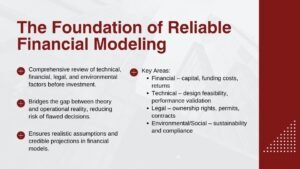
How Can Cash Flow Models Improve Project Finance Decisions?

A project finance cash flow model gives project finance decisions a boost by forecasting cash flows, testing the viability of the project, structuring the financing, and providing a disciplined framework for risk and return analysis for lenders and sponsors. It shows revenue projections, operating expenses, capital spending, and debt payments in a single coherent format, making it easy for stakeholders to make and stand up for decisions. 

What Is a Project Finance Cash Flow Model?

A project finance cash flow model is an Excel spreadsheet-based model that forecasts a project’s cash flows over the entire construction and operating life of the project, including revenues, operating expenses, capital expenditures and debt obligations. It connects all of the assumptions, including contracted revenues and interest rates, together into a single set of cash flow outputs that lenders and sponsors can back-test. The typical time on the model is fifteen to twenty-five years, depending on the asset class, after which comes the construction period. 

For learners, mastering the project finance cash flow model structure is the foundation before moving into more advanced debt sizing and equity return work. A robust model will break cash flow into operating cash flow, financing cash flow, and free cash flow to serve the needs of the operating cash flow stakeholder group, financing cash flow stakeholder group, and free cash flow for debt servicing. This division renders the model as a tool for analysis and a tool for communication between the sponsors, the lenders, and the advisors. 

Why Are Cash Flow Models Important in Project Finance?

The key reason why cash flow models are important is that project finance debt is not repaid from a sponsor’s balance sheet, but from the sponsored project’s operating cash flow, which means that lenders should have a good sense of how the project will generate cash flow before lending. The model calculates the amount of cash flow available after operating costs and reinvestment, and whether this amount is adequate to meet scheduled debt payments. If not, financing would be done on faith, not fact.

It also puts all parties to a negotiation—sponsors, lenders and advisors—on the same page with respect to the same set of numbers. The model instantly displays the impact of changes in assumptions (from delays in construction to new tariffs or increased financing rates, for example). This is the reason that cash flow modeling is at the core of any project finance transaction. 

Cash Flow Model Components

Component Purpose
Revenue Forecast Estimate future project income
Operating Expenses Forecast recurring project costs
CAPEX Plan and phase investment spending
Free Cash Flow Measure cash available for debt service
Debt Service Track scheduled principal and interest payments

How Do Cash Flow Forecasts Support Investment Decisions?
Project Finance Cash Flow Model

Cash flow forecasting is a tool used to aid investment decisions as it allows sponsors and investors to make comparisons with investment requirements. Project IRR, equity IRR, and payback period are all based directly on the forecasted cash flows. The outputs include these for comparison of competing projects.

Forecasts also include timing risk; for example, if the timing of cash flow is tight during ramp-up or in years of significant maintenance, etc., a static budget wouldn’t capture that. Whether to pursue a toll road or walk away is as much determined by the forecasting logic as is the decision to pursue a wind farm or walk away. 

How Is a Project Finance Debt Model Used?

A project finance debt model is employed to dimension the loan a project is able to repay, to organise the repayment plan, and to gauge the cash flow margin between repayments and cash flow under different scenarios. Combines debt and equity capital components, the weighted average cost of capital, and repayment provisions like sculpted amortization or mortgage-style amortization. It is used by the lenders to establish covenants, and by the sponsors to negotiate terms. 

Building a robust project finance debt model requires integrating debt, equity, WACC, and repayment structures into the same framework used to test project feasibility. It’s this integration that enables analysts to shift from whether a project can be financed, in most project finance deals, to on what terms. 

Debt Model Structure

Component Function
Loan Amount Determines project financing capacity
Interest Expense Represents the cost of borrowing
Principal Repayment Reduces outstanding debt over time
DSCR Measures the project’s repayment capacity
Reserve Accounts Provide a buffer during weaker periods

What Financial Assumptions Should Be Included?

Revenue growth, inflation, interest rates, tax rates, construction cost escalation, and operating cost trends are all important to the financial assumptions that impact the cash flow available for debt service. Rather than the generic estimates that lenders might use, analysts usually derive these assumptions from reports of lender investigations and contractual agreements and from market studies. Each assumption must be identified and derived from formulas to be able to be tested separately.

Some assumptions in renewable energy projects might be the price of a power purchase agreement, degradation rate of the equipment, etc, while in infrastructure projects they may be traffic volume, usage tariff, etc. One structured training modeling discipline is to store assumptions in a separate input sheet and not in a formula. 

Financial Assumptions

Assumption Example
Revenue Growth Annual increase in contracted sales
Inflation Rising operating and maintenance costs
Interest Rate Cost of project debt financing
Tax Rate Corporate tax obligation on profits
Construction Escalation Cost increases during the build phase

How Are Revenue and Operating Costs Forecasted?

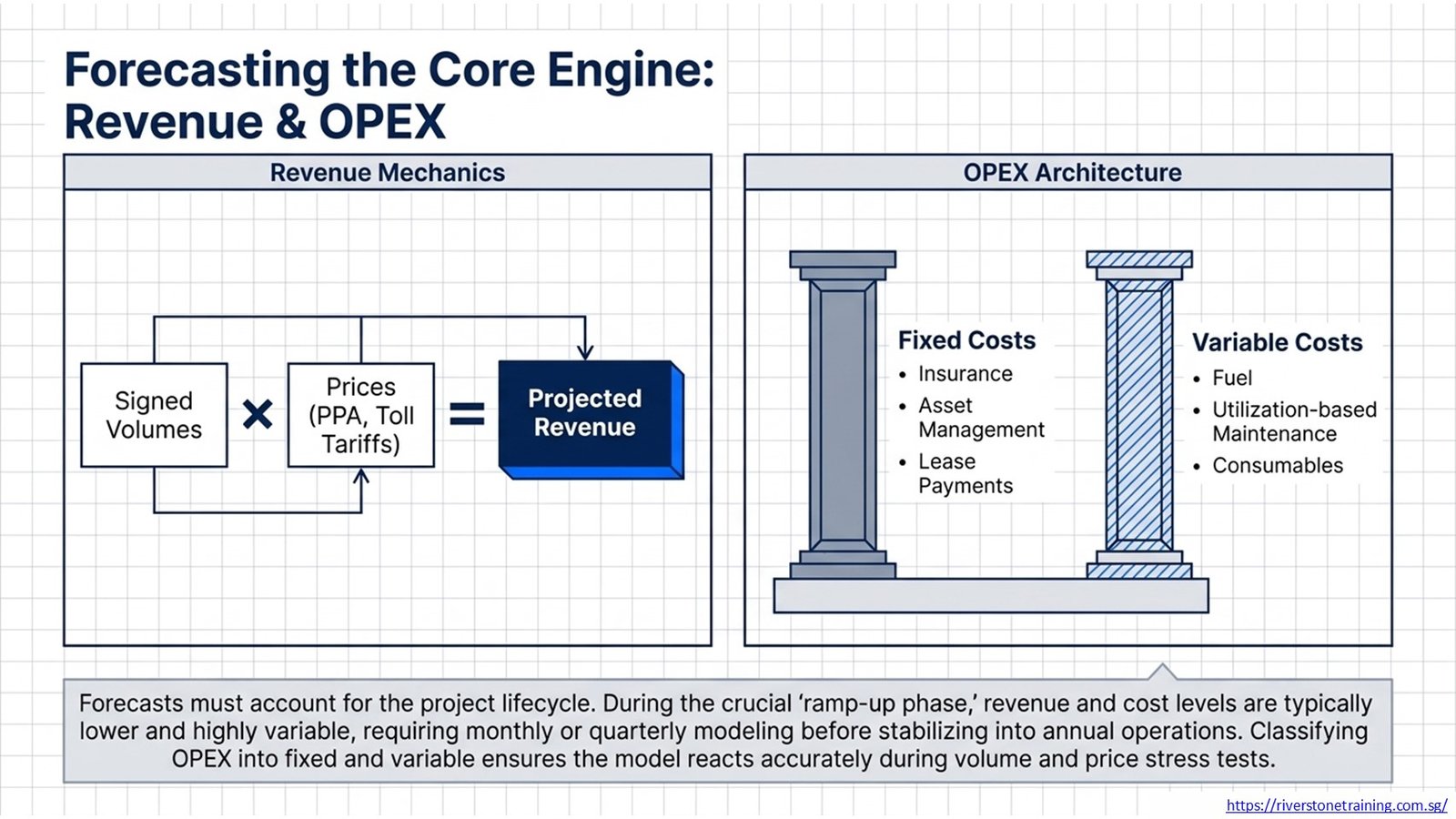
Revenue is generally projected based on signed volumes and prices (e.g., PPA, toll tariff), while operating costs are projected based on past benchmarks, which are adjusted for inflation and maintenance cycles. Both forecasts will need to take into account the stage of the project: typically, revenue and cost levels in the ramp-up phase tend to be lower and more variable. The analyses involve the construction of these forecasts monthly or quarterly during construction, and annually when operations become stable.

In project finance, the operating expenses typically consist of fixed costs (such as insurance and asset management costs), as well as variable costs (which depend on the output or utilization). These costs are classified as fixed and variable costs, which enables the model to react appropriately when volume and/or price assumptions are challenged in sensitivity analysis later on. 

How Do Cash Flow Models Measure Project Viability?
Project Finance Cash Flow Model

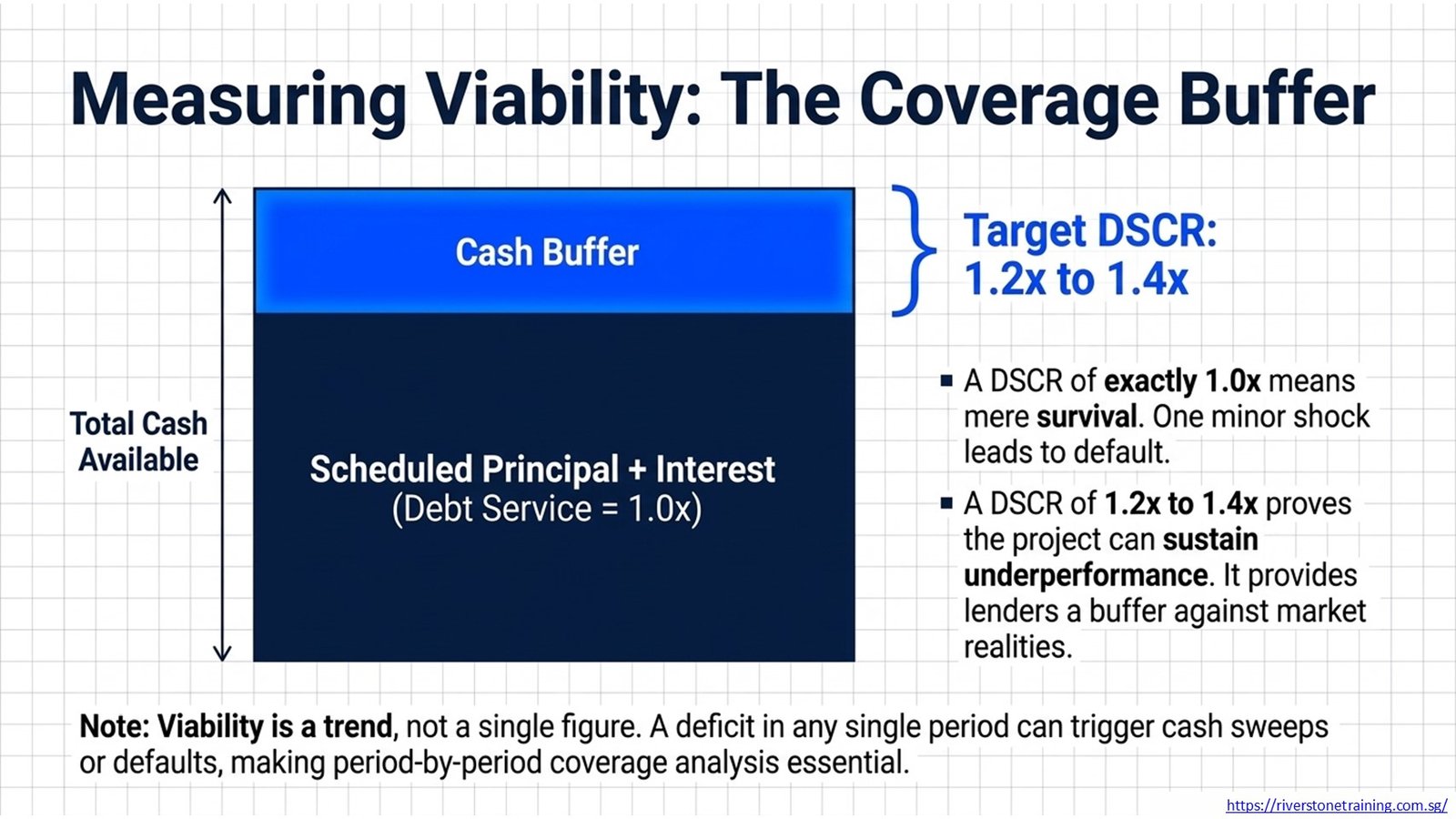
The basic measures of project viability for cash flow models are the Debt Service Coverage Ratio (DSCR), which is the ratio of cash available for debt service to scheduled principal and interest. A DSCR consistently in excess of the lender’s minimum requirement (typically 1.2x to 1.4x based on sector) indicates that the project has room for a little underperformance without default. Other measures of viability include Loan Life Coverage Ratio and equity IRR.

Viability is not a single figure; it’s a trend throughout the project’s life cycle. Even if the average DSCR is high, but the coverage ratio is low in one or two specific years, analysts will see this as real repayment risk, and not only summary averages. 

Why Are Debt Service Calculations Important?

Debt service calculations are significant since they will decide whether or not a project will have the ability to pay back its principal and interest on schedule, which is the one thing that any lender will be banking against. The calculations incorporate the loan amortization schedule and the expected free cash flow for the project to test coverage in each period, rather than only at financial close. If there is a deficit in any single period, it may cause covenant defaults or cash sweep clauses.

Analysts look at debt service in addition to other reserve accounts, including a debt service reserve account, which is used as a buffer during periods of lower cash flow. The dynamics between these reserves and the repayment schedule are a fundamental aspect of project finance debt structuring and review. 

How Do Sensitivity and Scenario Analysis Improve Decision-Making?
Project Finance Cash Flow Model

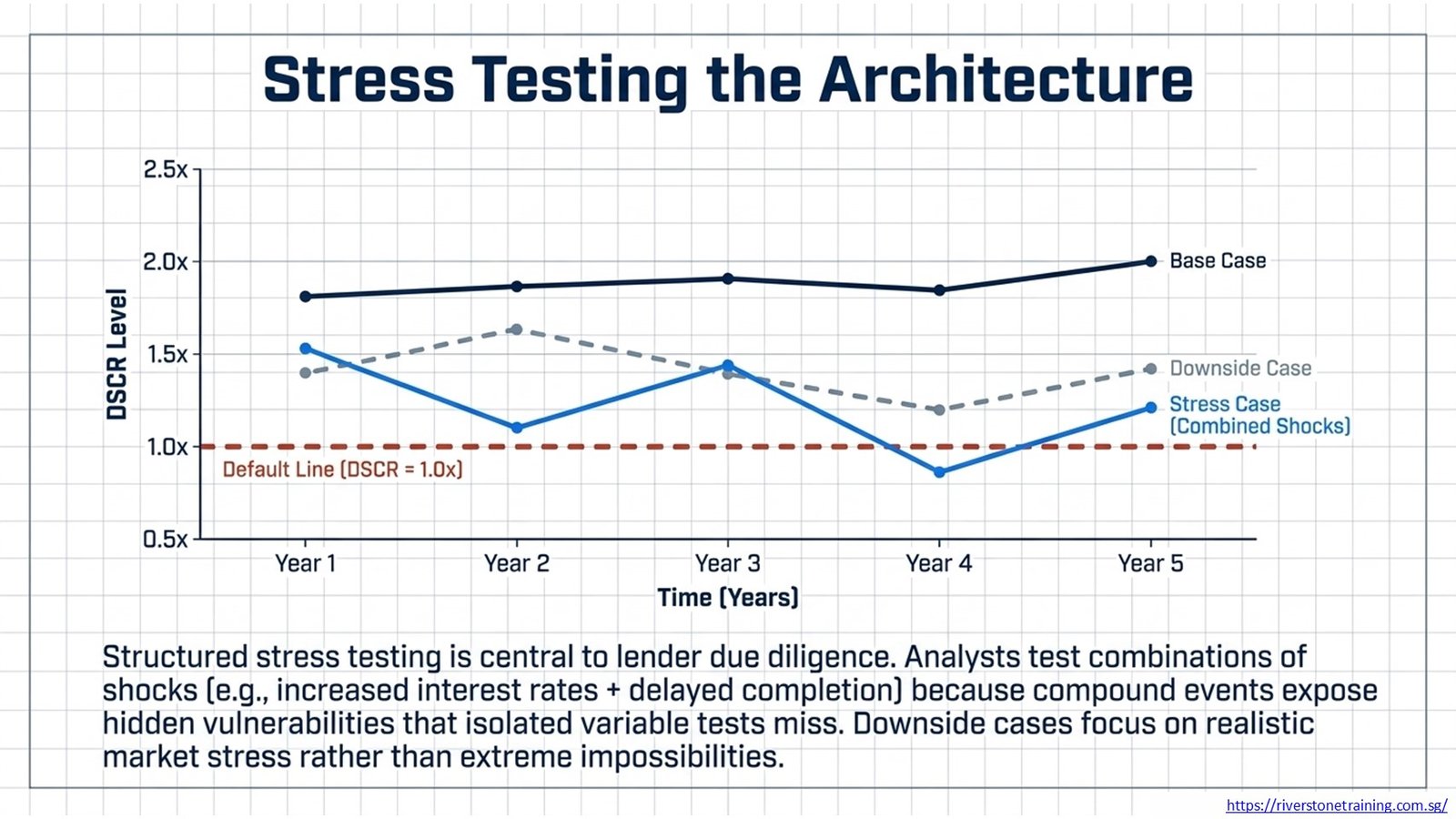
Scenario and sensitivity analysis help in decision-making by demonstrating the effect of changes in DSCR, IRR, etc. on key assumptions, such as an increase in interest rates or a longer construction completion. This allows sponsors and lenders to see which variables the viability of the project is most vulnerable to instead of one base case. Downside cases are generally designed to demonstrate realistic stress rather than extreme cases.

Analysts highlight revenue, cost, and financing assumptions, singly and together, because a combination of shocks can expose risks that are not captured in sensitivity to each variable. Structured stress testing is a common element of lender due diligence and one of the more advanced modeling skills acquired in the context of hands-on modeling practice. 

What Common Mistakes Should Analysts Avoid?

Some pitfalls are hard-coding some assumptions directly into the formulas, not distinguishing between the construction and operating parts of a project very clearly, and, when computing interest, making circular references around the interest calculation without proper handling. These errors may cause models to be hard to audit and generate incorrect results during negotiations. Any assumption should be able to be changed in one location without impacting downstream calculations, and calculations should be organized in a way that permits this.

Another error that analysts can make is to ignore a mismatch in timing, such as revenue that is received before cash is actually collected, which can affect the cash flow available to service debt. These errors are avoided most of the time if a consistent formatting, clear labelling, and logical structure of the sheets are established from the beginning. 

How Are Cash Flow Models Used by Lenders and Investors?

Cash flow models are used to determine the size of the debt facility, establish covenant limits, and determine repayment schedules that correspond with the expected cash flow from the project. The same model is employed by an investor to assess equity IRR and payback in a base and downside scenario. The two groups will generally want to do their own sensitivity runs prior to investing capital.

Analysts who create the model should clearly communicate their assumptions and be prepared to justify any of them during the due diligence process, since lenders and investors will use it directly. Therefore, the art of project finance modelling lies not only in its technical precision, but also in its ability to convey a message. 

How Do Project Finance Modeling Courses Teach Cash Flow Analysis?

Project finance modeling courses involve creating a full model from the ground up, beginning with the revenue and cost projections and then incorporating the debt sizing, DSCR calculation, and sensitivity analysis. The sequence reflects how models are really constructed and is not a set of pre-done models. Learners are usually guided through an infrastructure or renewable energy case study, where they apply each concept.

Structured Training also provides the discipline and experience in using Excel to create auditable, error-free models, such as formatting, document and formula construction, etc., and good documentation of assumptions. When lenders or investment committees review the models, they are expected to adhere to these same standards. 

Which Industries Use Project Finance Cash Flow Models?
Project Finance Cash Flow Model

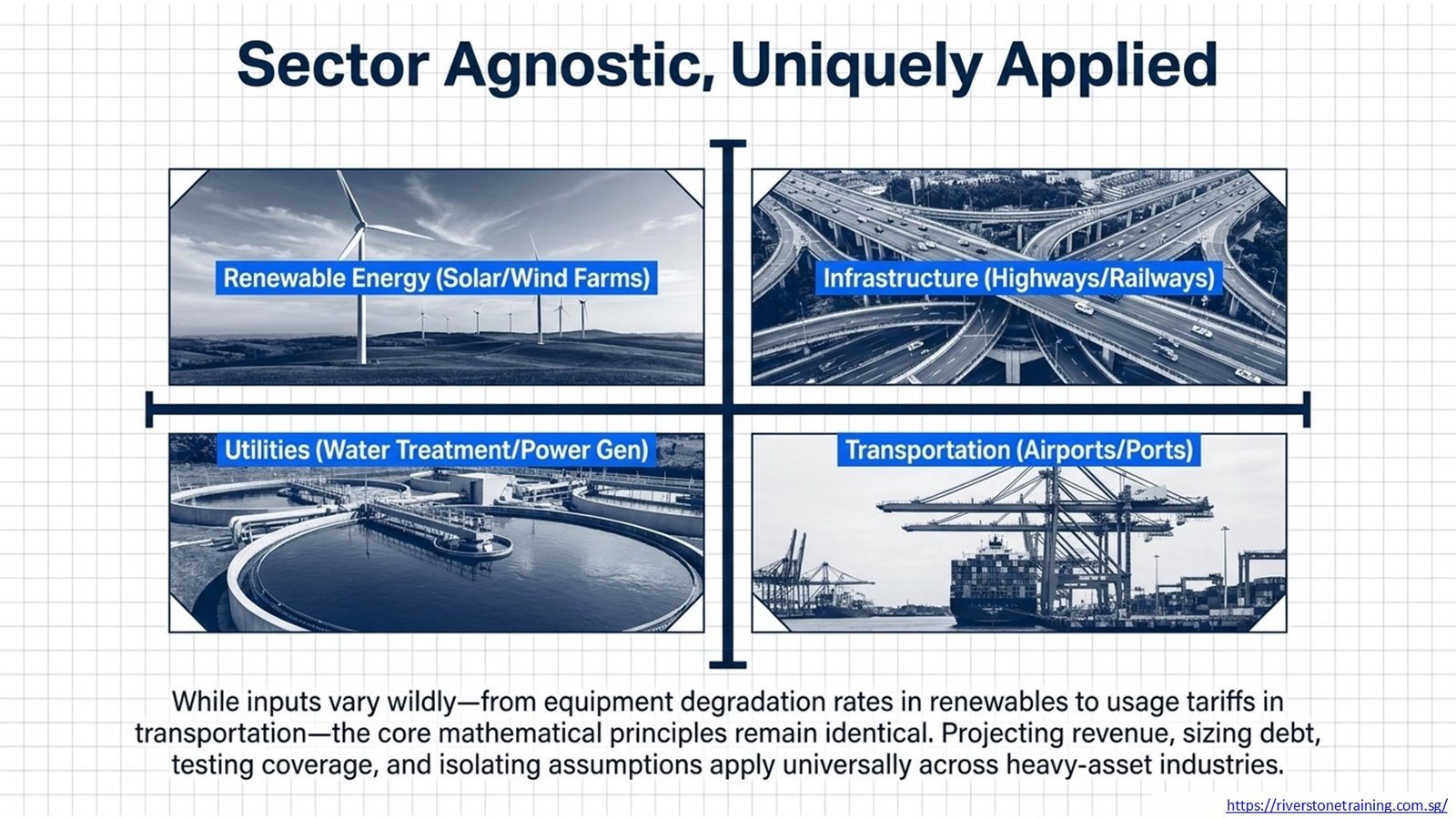
There are many types of cash flow models for project financing; they are applied to infrastructure, renewable energy, utilities, and transportation in all situations where large capital projects are funded from their own cash flow and not from a sponsor’s balance sheet. They are used to finance highways, railways, and airports, and to finance renewable energy developments, such as solar and wind farms. The same method is used with the water treatment and power generation assets of a utility.

The basic modeling principles remain the same regardless of sector: projection of revenue and costs, determination of size of debt, test of coverage, emphasis on assumptions. This uniformity is why project finance modeling skills are applicable to various industries. 

Industry Applications

Industry Typical Project
Renewable Energy Solar and wind farms
Infrastructure Highways and railways
Utilities Water treatment plants
Transportation Airports and ports

How Does Excel Improve Project Finance Modeling?

Unlike rigid software packages that can’t be reproduced or modified to suit the needs of the analyst or project, Excel also provides the flexibility to create custom, transparent formulas that can be traced, audited, and adjusted as assumptions change. Also, because of its popularity, it allows Excel-designed models to be analyzed and stress-tested by the lender, investors, and advisors without specialized software. A project finance model comes prepackaged with a variety of functions, such as amortization schedules, handling circular references, and switching between scenarios.

Another feature of project finance deals that Excel supports is the iterative process of project finance transactions where assumptions are changed numerous times throughout transaction negotiations. The ability to quickly change output without having to rebuild the model whenever the terms change is a benefit to the analyst, who can fluently add structure to flexible, error-checked Excel models. 

Why Is Practical Financial Modeling Experience Important?

The importance of practical financial modeling experience is due to the fact that project finance transactions do not always follow the textbook format, and financial analysts must tailor the models’ structure to the particular contracts, financing terms, and risk profile of each project. Solving real infrastructure and renewable energy case studies helps develop the intuition to make these changes properly. This is an experience that is hard to obtain by reading textbooks.

Practical modelling experience also helps to prepare professionals for the speed with which transactions take place in real life, as assumptions are constantly updated and outputs are subject to questioning from investment committees and lenders. Hence, the importance of modelling skills that are developed through training, based on real-world cases. 

Summary: How Cash Flow Models Support Project Finance Decisions

Decision Area How the Model Supports It
Investment Evaluation Derives project and equity IRR from forecasted cash flows
Financing Structure Sizes debt and equity through the debt model
Repayment Planning Schedules principal and interest against DSCR thresholds
Risk Assessment Tests assumptions through sensitivity and scenario analysis
Stakeholder Alignment Gives lenders, sponsors, and investors a shared set of numbers

Conclusion

A project finance cash flow model provides project sponsors, lenders, and investors with a framework that they can rely on to predict project revenues, operating expenses, and financing requirements, and determine if the cash flow they generate is sufficient to service the debt and generate acceptable returns. Putting all the predictions together into a single consistent model is the transformation of a bunch of assumptions into a financing action that stakeholders can explain when it gets examined.

The ability to analyse project finance feasibility with confidence and rely on a project finance debt model, with disciplined debt structuring, repayment planning, as well as lender-focused coverage metrics, will significantly improve the project finance financing analysis. One of the most effective approaches for project finance professionals to develop career-ready modeling skills is to strengthen this knowledge through structured training, hands-on practice with Excel, and real-world case studies.

Frequently Asked Questions

What is a project finance cash flow model?

A project finance cash flow model is an Excel-based, structured model that estimates the cash flow for the project in terms of revenues, operating expenses, capital investment and debt requirement during the construction and operating life of the project. It determines the cash available for debt service and equity returns that can be used by the lenders, sponsors and investors to assess the viability and financing terms of a project. 

Project finance is based on a project’s cash flow and not a sponsor’s balance sheet; this is why cash flow forecasting is important. Lenders need detailed forecasts in order to determine whether the project can consistently service its debt, handle the downside risks, and provide an acceptable equity return, and this is why accurate forecasts are so important. 

A project finance debt model will contain the loan amount, interest rate, repayment schedule, the DSCR calculations, and debt, equity, and WACC assumptions. It connects these factors with the project’s cash flow forecast to verify that the financing structure is viable throughout the project’s loan term, even in worst-case scenarios. 

Project finance modeling is made easy in Excel by providing a formula that lenders and investors can trace and audit, and is customizable for amortization schedules, DSCR calculations, and scenario switches. It is flexible and makes it easier to make fast changes to assumptions when negotiating a project finance transaction, as terms in these types of transactions are often revised. 

Project finance modeling courses cover revenue and expense forecasting, debt size and structure, calculation of DSCR and other coverage ratios, sensitivity analysis and scenario analyses. Courses also focus on practical uses of Excel techniques such as clean formula structure and assumption documentation in the context of real infrastructure and renewable energy case studies, preparing students for real-life transactions. 

The Project finance cash flow models are utilized by the lenders, sponsors, investors and financial advisors in infrastructure, renewable energy, utilities and transportation. Lenders apply them to size debt and to establish covenants, sponsors apply them to determine feasibility, and investors apply them to estimate equity returns prior to investing in a project. 

A project finance cash flow model gives project finance decisions a boost by forecasting cash flows, testing the viability of the project, structuring the financing, and providing a disciplined framework for risk and return analysis for lenders and sponsors. It shows revenue projections, operating expenses, capital spending, and debt payments in a single coherent format, making it easy for stakeholders to make and stand up for decisions. 

What Is a Project Finance Cash Flow Model?

A project finance cash flow model is an Excel spreadsheet-based model that forecasts a project’s cash flows over the entire construction and operating life of the project, including revenues, operating expenses, capital expenditures and debt obligations. It connects all of the assumptions, including contracted revenues and interest rates, together into a single set of cash flow outputs that lenders and sponsors can back-test. The typical time on the model is fifteen to twenty-five years, depending on the asset class, after which comes the construction period. 

For learners, mastering the project finance cash flow model structure is the foundation before moving into more advanced debt sizing and equity return work. A robust model will break cash flow into operating cash flow, financing cash flow, and free cash flow to serve the needs of the operating cash flow stakeholder group, financing cash flow stakeholder group, and free cash flow for debt servicing. This division renders the model as a tool for analysis and a tool for communication between the sponsors, the lenders, and the advisors. 

Why Are Cash Flow Models Important in Project Finance?

The key reason why cash flow models are important is that project finance debt is not repaid from a sponsor’s balance sheet, but from the sponsored project’s operating cash flow, which means that lenders should have a good sense of how the project will generate cash flow before lending. The model calculates the amount of cash flow available after operating costs and reinvestment, and whether this amount is adequate to meet scheduled debt payments. If not, financing would be done on faith, not fact.

It also puts all parties to a negotiation—sponsors, lenders and advisors—on the same page with respect to the same set of numbers. The model instantly displays the impact of changes in assumptions (from delays in construction to new tariffs or increased financing rates, for example). This is the reason that cash flow modeling is at the core of any project finance transaction. 

Cash Flow Model Components

Component Purpose
Revenue Forecast Estimate future project income
Operating Expenses Forecast recurring project costs
CAPEX Plan and phase investment spending
Free Cash Flow Measure cash available for debt service
Debt Service Track scheduled principal and interest payments

How Do Cash Flow Forecasts Support Investment Decisions?

Project Finance Cash Flow Model

Cash flow forecasting is a tool used to aid investment decisions as it allows sponsors and investors to make comparisons with investment requirements. Project IRR, equity IRR, and payback period are all based directly on the forecasted cash flows. The outputs include these for comparison of competing projects.

Forecasts also include timing risk; for example, if the timing of cash flow is tight during ramp-up or in years of significant maintenance, etc., a static budget wouldn’t capture that. Whether to pursue a toll road or walk away is as much determined by the forecasting logic as is the decision to pursue a wind farm or walk away. 

How Is a Project Finance Debt Model Used?

A project finance debt model is employed to dimension the loan a project is able to repay, to organise the repayment plan, and to gauge the cash flow margin between repayments and cash flow under different scenarios. Combines debt and equity capital components, the weighted average cost of capital, and repayment provisions like sculpted amortization or mortgage-style amortization. It is used by the lenders to establish covenants, and by the sponsors to negotiate terms. 

Building a robust project finance debt model requires integrating debt, equity, WACC, and repayment structures into the same framework used to test project feasibility. It’s this integration that enables analysts to shift from whether a project can be financed, in most project finance deals, to on what terms. 

Debt Model Structure

Component Function
Loan Amount Determines project financing capacity
Interest Expense Represents the cost of borrowing
Principal Repayment Reduces outstanding debt over time
DSCR Measures the project’s repayment capacity
Reserve Accounts Provide a buffer during weaker periods

What Financial Assumptions Should Be Included?

Revenue growth, inflation, interest rates, tax rates, construction cost escalation, and operating cost trends are all important to the financial assumptions that impact the cash flow available for debt service. Rather than the generic estimates that lenders might use, analysts usually derive these assumptions from reports of lender investigations and contractual agreements and from market studies. Each assumption must be identified and derived from formulas to be able to be tested separately.

Some assumptions in renewable energy projects might be the price of a power purchase agreement, degradation rate of the equipment, etc, while in infrastructure projects they may be traffic volume, usage tariff, etc. One structured training modeling discipline is to store assumptions in a separate input sheet and not in a formula. 

Financial Assumptions

Assumption Example
Revenue Growth Annual increase in contracted sales
Inflation Rising operating and maintenance costs
Interest Rate Cost of project debt financing
Tax Rate Corporate tax obligation on profits
Construction Escalation Cost increases during the build phase

How Are Revenue and Operating Costs Forecasted?

Revenue is generally projected based on signed volumes and prices (e.g., PPA, toll tariff), while operating costs are projected based on past benchmarks, which are adjusted for inflation and maintenance cycles. Both forecasts will need to take into account the stage of the project: typically, revenue and cost levels in the ramp-up phase tend to be lower and more variable. The analyses involve the construction of these forecasts monthly or quarterly during construction, and annually when operations become stable.

In project finance, the operating expenses typically consist of fixed costs (such as insurance and asset management costs), as well as variable costs (which depend on the output or utilization). These costs are classified as fixed and variable costs, which enables the model to react appropriately when volume and/or price assumptions are challenged in sensitivity analysis later on. 

How Do Cash Flow Models Measure Project Viability?

Project Finance Cash Flow Model

The basic measures of project viability for cash flow models are the Debt Service Coverage Ratio (DSCR), which is the ratio of cash available for debt service to scheduled principal and interest. A DSCR consistently in excess of the lender’s minimum requirement (typically 1.2x to 1.4x based on sector) indicates that the project has room for a little underperformance without default. Other measures of viability include Loan Life Coverage Ratio and equity IRR.

Viability is not a single figure; it’s a trend throughout the project’s life cycle. Even if the average DSCR is high, but the coverage ratio is low in one or two specific years, analysts will see this as real repayment risk, and not only summary averages. 

Why Are Debt Service Calculations Important?

Debt service calculations are significant since they will decide whether or not a project will have the ability to pay back its principal and interest on schedule, which is the one thing that any lender will be banking against. The calculations incorporate the loan amortization schedule and the expected free cash flow for the project to test coverage in each period, rather than only at financial close. If there is a deficit in any single period, it may cause covenant defaults or cash sweep clauses.

Analysts look at debt service in addition to other reserve accounts, including a debt service reserve account, which is used as a buffer during periods of lower cash flow. The dynamics between these reserves and the repayment schedule are a fundamental aspect of project finance debt structuring and review. 

How Do Sensitivity and Scenario Analysis Improve Decision-Making?

Project Finance Cash Flow Model

Scenario and sensitivity analysis help in decision-making by demonstrating the effect of changes in DSCR, IRR, etc. on key assumptions, such as an increase in interest rates or a longer construction completion. This allows sponsors and lenders to see which variables the viability of the project is most vulnerable to instead of one base case. Downside cases are generally designed to demonstrate realistic stress rather than extreme cases.

Analysts highlight revenue, cost, and financing assumptions, singly and together, because a combination of shocks can expose risks that are not captured in sensitivity to each variable. Structured stress testing is a common element of lender due diligence and one of the more advanced modeling skills acquired in the context of hands-on modeling practice. 

What Common Mistakes Should Analysts Avoid?

Some pitfalls are hard-coding some assumptions directly into the formulas, not distinguishing between the construction and operating parts of a project very clearly, and, when computing interest, making circular references around the interest calculation without proper handling. These errors may cause models to be hard to audit and generate incorrect results during negotiations. Any assumption should be able to be changed in one location without impacting downstream calculations, and calculations should be organized in a way that permits this.

Another error that analysts can make is to ignore a mismatch in timing, such as revenue that is received before cash is actually collected, which can affect the cash flow available to service debt. These errors are avoided most of the time if a consistent formatting, clear labelling, and logical structure of the sheets are established from the beginning. 

How Are Cash Flow Models Used by Lenders and Investors?

Cash flow models are used to determine the size of the debt facility, establish covenant limits, and determine repayment schedules that correspond with the expected cash flow from the project. The same model is employed by an investor to assess equity IRR and payback in a base and downside scenario. The two groups will generally want to do their own sensitivity runs prior to investing capital.

Analysts who create the model should clearly communicate their assumptions and be prepared to justify any of them during the due diligence process, since lenders and investors will use it directly. Therefore, the art of project finance modelling lies not only in its technical precision, but also in its ability to convey a message. 

How Do Project Finance Modeling Courses Teach Cash Flow Analysis?

Project finance modeling courses involve creating a full model from the ground up, beginning with the revenue and cost projections and then incorporating the debt sizing, DSCR calculation, and sensitivity analysis. The sequence reflects how models are really constructed and is not a set of pre-done models. Learners are usually guided through an infrastructure or renewable energy case study, where they apply each concept.

Structured Training also provides the discipline and experience in using Excel to create auditable, error-free models, such as formatting, document and formula construction, etc., and good documentation of assumptions. When lenders or investment committees review the models, they are expected to adhere to these same standards. 

Which Industries Use Project Finance Cash Flow Models?

Project Finance Cash Flow Model

There are many types of cash flow models for project financing; they are applied to infrastructure, renewable energy, utilities, and transportation in all situations where large capital projects are funded from their own cash flow and not from a sponsor’s balance sheet. They are used to finance highways, railways, and airports, and to finance renewable energy developments, such as solar and wind farms. The same method is used with the water treatment and power generation assets of a utility.

The basic modeling principles remain the same regardless of sector: projection of revenue and costs, determination of size of debt, test of coverage, emphasis on assumptions. This uniformity is why project finance modeling skills are applicable to various industries. 

Industry Applications

Industry Typical Project
Renewable Energy Solar and wind farms
Infrastructure Highways and railways
Utilities Water treatment plants
Transportation Airports and ports

How Does Excel Improve Project Finance Modeling?

Unlike rigid software packages that can’t be reproduced or modified to suit the needs of the analyst or project, Excel also provides the flexibility to create custom, transparent formulas that can be traced, audited, and adjusted as assumptions change. Also, because of its popularity, it allows Excel-designed models to be analyzed and stress-tested by the lender, investors, and advisors without specialized software. A project finance model comes prepackaged with a variety of functions, such as amortization schedules, handling circular references, and switching between scenarios.

Another feature of project finance deals that Excel supports is the iterative process of project finance transactions where assumptions are changed numerous times throughout transaction negotiations. The ability to quickly change output without having to rebuild the model whenever the terms change is a benefit to the analyst, who can fluently add structure to flexible, error-checked Excel models. 

Why Is Practical Financial Modeling Experience Important?

The importance of practical financial modeling experience is due to the fact that project finance transactions do not always follow the textbook format, and financial analysts must tailor the models’ structure to the particular contracts, financing terms, and risk profile of each project. Solving real infrastructure and renewable energy case studies helps develop the intuition to make these changes properly. This is an experience that is hard to obtain by reading textbooks.

Practical modelling experience also helps to prepare professionals for the speed with which transactions take place in real life, as assumptions are constantly updated and outputs are subject to questioning from investment committees and lenders. Hence, the importance of modelling skills that are developed through training, based on real-world cases. 

Summary: How Cash Flow Models Support Project Finance Decisions

Decision Area How the Model Supports It
Investment Evaluation Derives project and equity IRR from forecasted cash flows
Financing Structure Sizes debt and equity through the debt model
Repayment Planning Schedules principal and interest against DSCR thresholds
Risk Assessment Tests assumptions through sensitivity and scenario analysis
Stakeholder Alignment Gives lenders, sponsors, and investors a shared set of numbers

Conclusion

A project finance cash flow model provides project sponsors, lenders, and investors with a framework that they can rely on to predict project revenues, operating expenses, and financing requirements, and determine if the cash flow they generate is sufficient to service the debt and generate acceptable returns. Putting all the predictions together into a single consistent model is the transformation of a bunch of assumptions into a financing action that stakeholders can explain when it gets examined.

The ability to analyse project finance feasibility with confidence and rely on a project finance debt model, with disciplined debt structuring, repayment planning, as well as lender-focused coverage metrics, will significantly improve the project finance financing analysis. One of the most effective approaches for project finance professionals to develop career-ready modeling skills is to strengthen this knowledge through structured training, hands-on practice with Excel, and real-world case studies.

Frequently Asked Questions

What is a project finance cash flow model?

A project finance cash flow model is an Excel-based, structured model that estimates the cash flow for the project in terms of revenues, operating expenses, capital investment and debt requirement during the construction and operating life of the project. It determines the cash available for debt service and equity returns that can be used by the lenders, sponsors and investors to assess the viability and financing terms of a project. 

Project finance is based on a project’s cash flow and not a sponsor’s balance sheet; this is why cash flow forecasting is important. Lenders need detailed forecasts in order to determine whether the project can consistently service its debt, handle the downside risks, and provide an acceptable equity return, and this is why accurate forecasts are so important. 

A project finance debt model will contain the loan amount, interest rate, repayment schedule, the DSCR calculations, and debt, equity, and WACC assumptions. It connects these factors with the project’s cash flow forecast to verify that the financing structure is viable throughout the project’s loan term, even in worst-case scenarios. 

Project finance modeling is made easy in Excel by providing a formula that lenders and investors can trace and audit, and is customizable for amortization schedules, DSCR calculations, and scenario switches. It is flexible and makes it easier to make fast changes to assumptions when negotiating a project finance transaction, as terms in these types of transactions are often revised. 

Project finance modeling courses cover revenue and expense forecasting, debt size and structure, calculation of DSCR and other coverage ratios, sensitivity analysis and scenario analyses. Courses also focus on practical uses of Excel techniques such as clean formula structure and assumption documentation in the context of real infrastructure and renewable energy case studies, preparing students for real-life transactions. 

The Project finance cash flow models are utilized by the lenders, sponsors, investors and financial advisors in infrastructure, renewable energy, utilities and transportation. Lenders apply them to size debt and to establish covenants, sponsors apply them to determine feasibility, and investors apply them to estimate equity returns prior to investing in a project. 

Related Posts

Everything You Need to Know About Project Financial Modeling Courses

Contact Riverstone Training today to explore our specialized project financial modeling courses designed for professionals and teams.