A project finance model evaluates a project’s viability by forecasting revenue, costs, capital expenditure and financing throughout its life. This article explains how project assumptions and financing fit together, including key metrics such as project finance model DSCR, IRR and NPV, to assess project performance and sensitivity to changing conditions.

What Is a Project Finance Model?
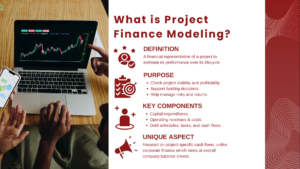
A project finance model is a financial model that is created around an individual project, such as an infrastructure project, power plant or toll road, rather than around an existing company. It depicts the construction cost, operating revenue, operating cost, and debt service for the project over the project life, which is usually the construction, ramp-up and an extended operating phase of 15 to 30 years or more.
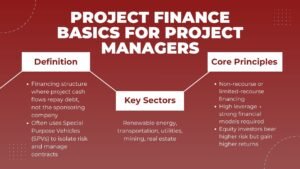
Since most projects of this type are funded on a non-recourse or limited-recourse basis, the lender only gets back what the project itself generates in cash flow, and not the sponsor’s overall balance sheet. This is why project finance is a key instrument in determining whether or not the project is capable of paying the debt and equity required to fund it, before construction starts.
| Model Component | What It Captures | Why It Matters |
| Project Assumptions | Construction period, operating life, capacity | Sets the structure the entire model is built on |
| Revenue Forecast | Output, pricing, contracted or market revenue | Drives the project’s income-generating capacity |
| Operating Costs | Maintenance, staffing, fuel, insurance | Determines net cash available for debt service |
| Financing Structure | Debt tranches, equity, repayment terms | Defines how the project is funded and repaid |
Why Is Project Finance Modeling Used to Assess Project Viability?
Project finance modeling is employed because it is a tool that converts the technical and commercial assumptions of a project into a single financial image, which lets the project stand or fall. Project finance is different from a corporate finance model, which can rely on various streams of revenue or assets, in that it must demonstrate its ability to pay its operating costs, debt service, and generate a return to equity investors from a single project—one that is largely isolated.
That’s why lenders and sponsors look to the model as the predominant decision-making factor prior to financial close. When a project’s projected cash flow is insufficient and/or too sensitive to changes in assumptions, the project is generally not ready for the financing to proceed and may require some adjustments to the capital structure, assumptions, and/or risk mitigation measures.
How Do Project Assumptions Shape the Model?
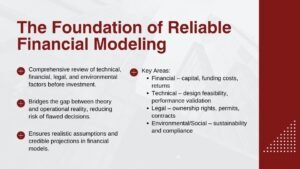
Each project finance model begins with a group of structural assumptions such as project duration, project capital cost, project operating life, capacity levels or project output, and the regulatory or contractual environment in which the project will function. These assumptions put constraints on all the other parameters of the model – revenue cannot be forecast if you don’t know what the project is going to produce, and debt cannot be sized if you don’t know for how long the project will provide cash flow.
Assumptions should be based on engineering studies, market analysis, and contractual arrangements (offtakes, concessions, etc.). rather than on generic estimates. Typically, the assumptions in a project finance model are very closely reviewed by the project sponsor and lender prior to accepting the model’s output, and a project finance model is only as reliable as the assumptions that it is based on.
How Are Revenue Forecasts Built Into a Project Finance Model?
The nature of the project’s contractual arrangement is a key factor in revenue projections. A project that includes a long-term power purchase agreement or availability-based concession will anticipate revenue from fixed pricing terms or formula-based pricing terms, whereas a merchant project that is exposed to market pricing will require more uncertainty with respect to revenue because it will be based on projected output and market price assumptions.
Either way, the model needs to accommodate periods of ramping up, seasonality, and any ramp-up or price adjustments that may be included in the contract. One of the most frequent ways that a project finance model overstates viability is by forecasting revenues that are too high, because every other downstream calculation is based on revenue.
How Are Operating Costs Modeled?
In a project finance model, operating costs are usually cash flows at the same operating period as the revenue cash flows, and they generally consist of maintenance, staffing, insurance, fuel/inputs and periodic major maintenance reserves. Fixed and variable cost components are typically distinguished, as the variable costs will change depending on the amount of the project’s output, but the fixed costs will not change.
Expenses that have a direct impact on a project’s cash flow, such as debt payments, can make a project look attractive when the cash flow assumptions are too low, especially if the major maintenance or lifecycle replacement costs are not anticipated and instead are assumed to be annual expenses. A good model will incorporate reserve accounts that cover these periodic expenses over the operating period.
How Is Capital Expenditure Incorporated Into the Model?
Capital expenditure is concentrated in a project finance model, and it takes place during the construction period, when capital is used to set up the project and build the asset, which won’t produce revenue until the completion of the project. The drawdown schedule is tracked against the construction budget, and any overrun or delay in the construction process will directly impact the financing required and when the project becomes cash-generating.
Capital expenditure also resurfaces towards the end of the model as a large operating cost item for maintenance or replacement of assets. Since capex during construction requires no revenue, it is usually the riskiest stage of the project, and this is why the financing structure and covenants are designed.
How Do Debt and Equity Financing Fit Into the Model?
The funding of project finance is usually done with a significant amount of debt compared to equity, because cash flow is predictable and contracted, and this will give the lender the confidence to be repaid over the long term on a reliable basis. The model calculates the interest and principal repayments, assumes a debtor’s cash flow, and determines a repayment schedule, usually in the form of sculpted repayments, which can be determined by the cash flow profile of the project, and calculates interest and principal amounts to be repaid in each period.
Equity investors receive returns after operating costs and debts have been paid, and are thus more exposed to changes in the underlying assumptions for the project than are the lenders with their fixed repayment schedule. One of the key findings the model is designed to prove is the link between debt sizing, debt terms and equity returns.
How Are Cash Flow Projections Built for a Project?
Cash flow projections combine revenue, operating expenses, capital expenditures and financing into one forecast per period, typically quarterly or semi-annually, reflecting the typical debt repayment periods. The model will calculate the cash flow available for debt service (operating cash flow minus financing costs) and compare it to the debt repayments due during that period.
This cash flow waterfall is usually carried out in a specific order, starting with operating expenses, then debt service, then contribution to savings account, and lastly surplus cash to equity. The way the model is set up around this waterfall makes it easy for lenders to see just how big a cushion they have before a shortfall will impact debt repayment.
How Do Lenders Use DSCR to Evaluate Debt Repayment Capacity?
The debt service coverage ratio, or DSCR, is the ratio of the project’s cash flow available for debt service to the debt service required for a particular period in the project’s life, and is the most watched ratio in project finance. For instance, a DSCR of 1.3x indicates that the business is generating 30% more cash than is required to pay the debts that fall due over the next year, which means that the lender has a margin of safety in case of failure.
Lenders typically set a minimum DSCR covenant, and a project finance model DSCR analysis is usually run across the entire debt tenor, not just a single period, since a project can pass in strong years but fall below covenant in a weaker one. Both the average and minimum DSCR across the repayment period are used to judge whether the financing structure is sustainable.
| Metric | What It Measures | Primary Audience |
| DSCR | Cash flow coverage of debt repayment | Lenders |
| LLCR | Cash flow coverage over the remaining loan life | Lenders |
| IRR | Annualized rate of return on invested capital | Equity investors, sponsors |
| NPV | Present value of future cash flows at a discount rate | Sponsors, investors |
What Do IRR and NPV Reveal About Project Returns?
The internal rate of return (IRR) indicates the annual rate of return the project will deliver on the equity invested and is generally computed on an equity basis and for the project as a whole. A project that has an equity IRR that exceeds the minimum threshold required by the investors is a project that can be deemed to be attractive. Conversely, a project with an equity IRR below the investors’ minimum acceptable threshold can be deemed to be not attractive, because the investors are not given sufficient return for the risk taken.
NPV is a measure that calculates the value in today’s dollars of all the future cash flows of a project, using a selected discount rate, and indicates whether or not the project generates value in absolute terms (not a percentage return). A positive NPV means that the project will create more value for the sponsor than the cost of capital, and a combination of NPV and IRR will provide the sponsor with more information than each value can provide on its own.
How Does Sensitivity Analysis Support Project Viability Assessment?
Sensitivity analysis involves varying one assumption at a time (construction cost, output volume, operating cost, or interest rate, etc.) and observing how the changes affect the DSCR, IRR, and NPV. This helps to isolate the assumptions that may have the highest degree of impact on the viability of a project, assisting the sponsor(s) and lender(s) to appreciate the point(s) at which the financial performance of a project is most vulnerable to forecasting error or market movement.
For instance, if a 10% increase in construction costs or a 10% decrease in output results in a DSCR below the lender’s minimum covenant, then the borrower has a 10% cushion before reaching that limit. This kind of targeted testing is much more informative than a base-case forecast, as it indicates the specific areas of pressure that might impact debt repayment or investor returns.
How Does Scenario Analysis Help Stakeholders Understand Risk?
Sensitivity analysis changes one assumption at a time, whereas scenario analysis applies more than one change to the assumptions in a consistent way to arrive at realistic combinations of events, including one where the downturn scenario is assumed (lower output, higher operating costs, and higher financing costs). This provides stakeholders with a more realistic sense of the project’s ability to weather real-life storms and adverse events, not just individual ones.
Understanding the effects of running DSCR, IRR, and NPV analysis under each scenario can assist lenders and sponsors in determining financing terms, covenant levels, and terms of reserve requirements that will ensure that the project remains viable even if conditions turn out to be less favorable than the base case, which is an important aspect of structuring the financing prior to committing funds.
| Scenario | Key Assumption Changes | Effect on DSCR / Returns |
| Base Case | Assumptions as forecast | Meets lender and investor targets |
| Upside Case | Higher output, lower costs | Stronger DSCR and returns |
| Downside Case | Lower output, higher costs, higher financing costs | Reduced DSCR, tests covenant headroom |
What Common Errors Can Undermine a Project Finance Model?
Typical mistakes are overly optimistic revenue or output expectations, understated, large maintenance or lifecycle capital costs, and debt sizing that does not adequately account for the cash flow waterfall, or reserve account requirements. All can give the illusion of a healthier project than it really is, and this is a big risk in such long-term and capital-intensive projects.
There can also be circularity errors, as interest expense is related to the amount of debt outstanding, which is dependent on cash flow, which is dependent on interest expense. Models that don’t do this right, or that don’t connect the construction-period drawdowns properly to the operating-period cash flow, can come out with reasonable DSCRs and IRRs, but are not subject to close examination.
| Error | Potential Consequence |
| Overly optimistic revenue assumptions | Overstated viability |
| Underestimated major maintenance costs | Understated future cash needs |
| Incorrect debt sizing or waterfall | Inaccurate DSCR and covenant testing |
| Unresolved interest circularity | Unreliable cash flow and returns output |
How Can Beginners Learn to Build Project Finance Models?
It’s not just about general project finance modeling skills, however, because creating a project finance model well involves specific skills, including structuring a construction-to-operations timeline, creating a cash flow waterfall, sizing debt against DSCR targets, and running sensitivity and scenario analysis properly. Usually, these can be acquired in a more structured, practice-based manner rather than learned purely from corporate financial modelling experience.
For professionals starting out, a project finance modeling for beginners course provides a structured path from foundational modeling skills into project-specific techniques, including debt sizing, DSCR and LLCR calculations, and scenario testing, giving beginners a practical grounding before they work on live project financings.
Why Is Project Finance Modeling Important for Investment and Financing Decisions?
The value of project finance modeling stems from its role as the most important instrument for lenders and sponsors to determine whether to invest in a project, negotiate financing terms and establish covenants to safeguard the return on the investment over the life of a project. The debt-to-equity ratio, the tenor of the loan and any other significant decision for a project financing are all based on what the model predicts the cash flow, DSCR, IRR and NPV will look like.
These projects are often funded for 15 years or more and a good project finance model is alive and well after financial close to track the real-life performance against the initial forecast and to sensitize the effect of varying conditions long after the projects are finished. This is because the model is as significant during operations as it is when it is used to secure the original financing.
| Skill | Why It Matters |
| Revenue and Cost Forecasting | Establishes the project’s cash-generating capacity |
| Debt Sizing and DSCR Analysis | Determines lender comfort with repayment risk |
| Cash Flow Waterfall Structuring | Defines the priority of payments to debt and equity |
| Sensitivity and Scenario Analysis | Tests resilience under changing conditions |
| IRR and NPV Interpretation | Evaluates whether returns justify the investment |
Conclusion
A project finance model is a model that tests the viability of a project by combining project assumptions, revenue, operating costs, capital expenditure, and financing into one cash flow forecast and then analyzing the forecast against a range of project assumptions, including DSCR, IRR, and NPV. This can be expanded with sensitivity and scenario analysis to demonstrate to stakeholders how individual changes in assumptions or sets of adverse conditions might impact the debt repayment capability and investor return on investments prior to closing.
The underlying project finance model, and its reliability, is critical in order to get lenders and sponsors to invest in such projects, which are large, long-dated, and often funded on a non-recourse basis. For professionals seeking to enhance this ability, the emphasis is on creating comprehensive, properly connected models, performing tests with simulated scenarios, and working with real project structures instead of formulas.