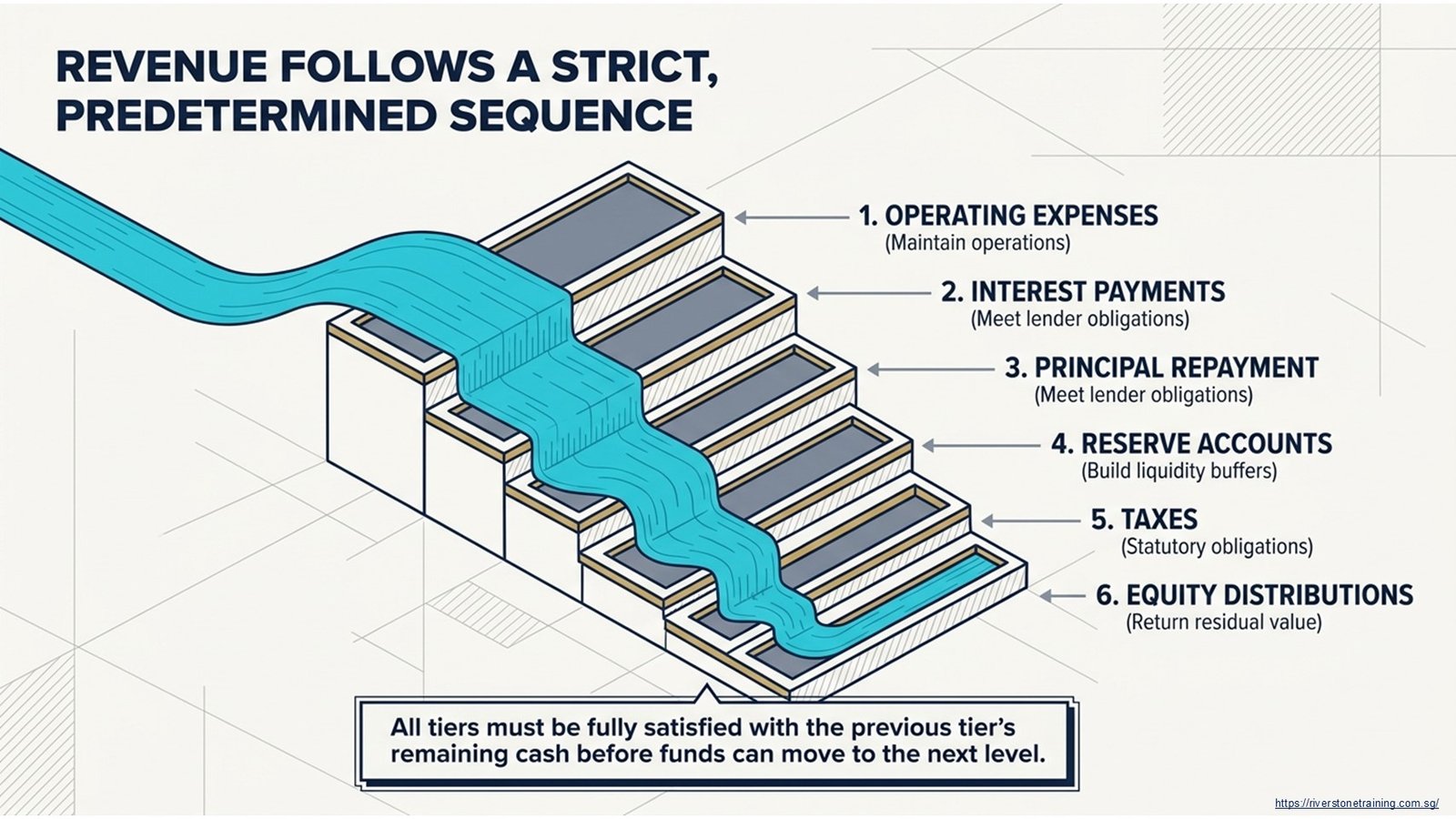
A cash flow waterfall is a technique for allocating the revenue in a project by following a predetermined priority sequence: operating expenses, debt service, reserve accounts, taxes, and equity distributions. This sequencing is incorporated directly into project finance modeling cash flow waterfall Excel structures and is at the heart of every bankable infrastructure/energy financing model.
What Is a Cash Flow Waterfall in Project Finance?
A Cash Flow Waterfall represents the order in which project revenues are allocated to Operations, Lenders, Reserve Accounts, Tax Authorities, and Equity Holders. This is the basis for all financial models in project finance, as it determines the sequence and timing of payments and who is paid.
The waterfall is built directly into the analysts’ Excel model and cash flow automatically down through the tiers each period. This mechanical sequencing is how lenders and sponsors can determine, on a monthly basis, if a project is producing sufficient cash to pay all obligations.
Cash Flow Waterfall Priority Table
| Priority | Cash Flow Allocation |
| 1 | Operating expenses |
| 2 | Interest payments |
| 3 | Principal repayment |
| 4 | Reserve accounts |
| 5 | Taxes |
| 6 | Equity distributions |
Why Is the Cash Flow Waterfall Important?
The waterfall is important as it provides a disciplined framework for the repayment of project revenue and facilitates the communication of project health to investors, all the while shielding lenders. If this is not the case, cash can be paid out to equity holders before repayments are made on debt, potentially undermining lender confidence and jeopardising the deal’s bankability.
Having a well-modeled waterfall also provides sponsors with an early warning system. If there is less cash flow coming in than needed to cover the lower tier, the model will flag this shortfall long before it becomes a cash shortfall.
How Is Project Revenue Allocated Step by Step?
Revenue allocation is performed in an order: first operating expenses are covered, then interest and principal repayments, then funding for the reserve account, then tax obligations, and lastly, equity distributions. All tiers need to be fully satisfied in order with the previous tier’s cash before the cash moves to the next tier.
This is generally represented in Excel as a “chain” of formulas, with each formula referencing the previous row with the remaining cash balance. This sequential movement of funds from revenue collection to equity distribution can be seen in the table below.
Revenue Allocation Sequence Table
| Stage | Purpose |
| Revenue Collection | Generate project cash inflows |
| Operating Costs | Maintain project operations |
| Debt Service | Meet lender obligations |
| Reserve Funding | Build required liquidity buffers |
| Tax Payment | Meet statutory obligations |
| Equity Distribution | Return value to investors |
What Expenses Are Paid First in a Cash Flow Waterfall?
Operating expenses are paid before anything else since, without the project’s physical operation, there will be no future income. This includes costs for the day-to-day operations of an infrastructure or energy asset to keep it operating, such as maintenance, staffing, utilities, insurance, etc.
For a solar or wind project, for instance, the operating costs include regular maintenance and connection to the grid fees, with no money to be used for debt service until the project is up and running. It is crucial that these costs be modeled correctly because if they are not, the project will appear to have more debt capacity than it actually does, and the oexp will be higher than it should be for the next layer.
How Is Debt Service Prioritized?
Reserve accounts are next up in the waterfall, followed by debt service (interest payments and then principal repayment) since lenders need to get priority access to project cash flows when they lend it. This is typically secured by the loan contract, and it is implemented via financial covenants based on debt service coverage ratio, etc.
Most models in Excel first compute the interest on the outstanding loan balance and then use the remaining cash to pay any scheduled principal. Project finance modellers complete training in the creation of these calculations so that any shortfall is immediately apparent and not “absorbed” in another part of the model.
Why Are Reserve Accounts Included in Project Finance Models?
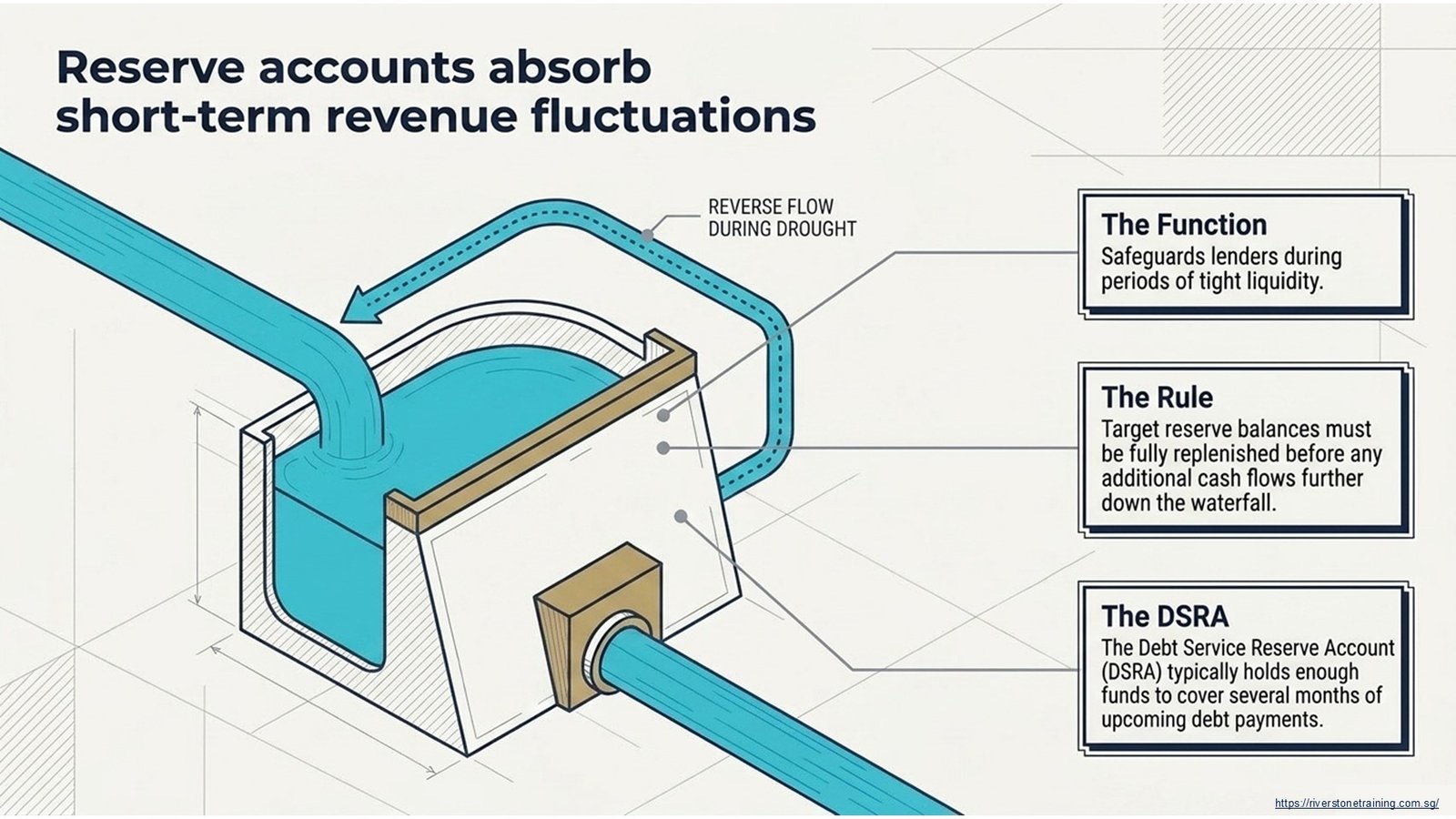
Reserve accounts are also part of a bank’s strategy to safeguard lenders from short-term fluctuations in cash flow, so that lenders are able to pay back their debt obligations when funds are tight. For instance, a Debt Service Reserve Account will generally be filled with sufficient funds to cover the next few months’ worth of debt repayments.
Reserve balances are assumed as desired levels that need to be replenished prior to any additional flow moving along the waterfall. The table below highlights the main types of reserves that are typically included in a project finance model.
Reserve Account Types Table
| Reserve Account | Purpose |
| DSRA | Cover debt payments during cash shortages |
| Maintenance Reserve | Fund major maintenance costs |
| Working Capital Reserve | Support operational liquidity |
| Contingency Reserve | Manage unexpected expenses |
How Are Taxes and Other Obligations Accounted For?
Project income is taxed after operating expenses, interest, and depreciation, generally before equity distributions, depending on tax laws and deal structure. It is important to get the tax logic correct in the model, because the timing of taxes impacts the cash flow that equity investors are receiving in any period.
Other statutory obligations may also be included in some models (such as regulatory fees or royalties) and should be placed in the right spot in the waterfall. It is important for analysts to verify the precise contractual scheme of each project, as the tax and obligation placement may differ across deal structures.
When Are Equity Investors Paid?
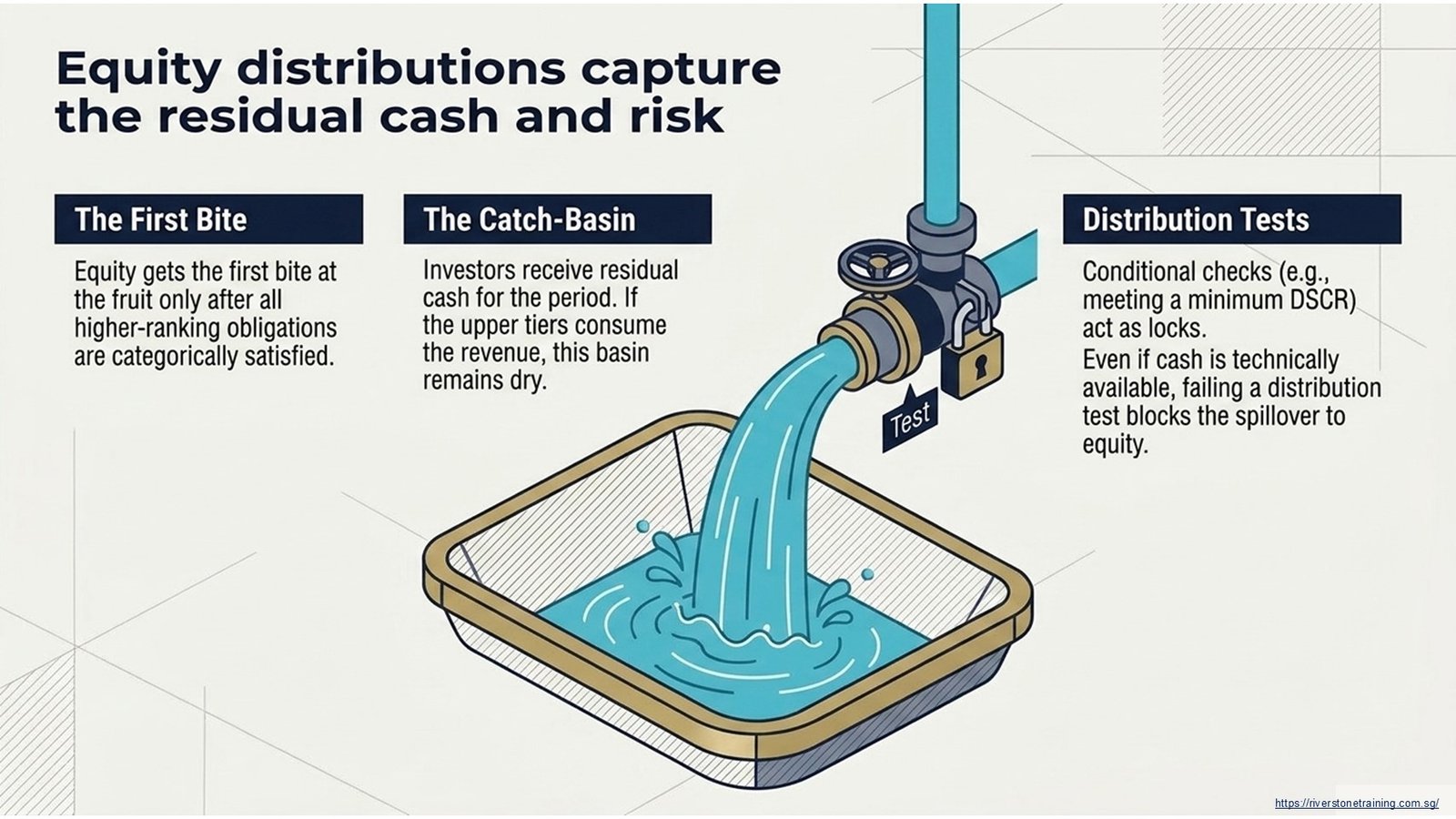
Equity investors receive distributions only after operating expenses, debt service, reserve requirements and taxes are paid out for the period. This is the risk profile of a project finance position: Equity gets the first bite at the fruit and only after it is assured that higher-ranking obligations have been paid.
Some deals include distribution tests, such as a minimum debt service coverage ratio, that must be met before equity can be paid even if cash is technically available. Excel models typically encode these tests as conditional checks that block or allow the equity tier based on the project’s current financial performance.
How Is a Cash Flow Waterfall Built in Excel?
Creating the cash flow waterfall in Excel begins with a revenue and operating cost forecast, and then builds a debt schedule, a reserve account logic, a tax calculation, and lastly a line for equity distribution. All these sections are connected sequentially, and then when the cash flow is run, it cascades down automatically. One common practice is to have a row for each tier, with formulas that pull data from the preceding tier.
This layered approach, taught in depth through project finance modeling cash flow waterfall Excel training, allows learners to model realistic infrastructure and energy deals rather than simplified textbook examples. One of the more technical skills learned from hands-on experience is the correct formula logic and circularity handling, especially for interest based on an average debt balance.
What Common Errors Should Analysts Avoid?
One common mistake is trying to model equity distributions before debt service and reserve requirements have been paid back, which can lead to a skewed understanding of the project’s risk. Another frequent error is incorrect linking of the balances of the reserve accounts so that a shortage in one accounting period does not continue to the next.
The analyst should also not enter values directly in the cells, but use formulas, as this will prevent the model from being flexible with varying revenue or cost scenarios. Structured training can help the learners identify and prevent these mistakes from occurring before they make it to a model shared with the lenders or the investment committees.
How Does the Cash Flow Waterfall Support Lender Decision-Making?
The waterfall output is used by lenders to determine if a project will be able to service its debt over the duration of the financing, and frequently they will refer to debt service coverage ratios that come directly from the model. A waterfall of tight or negative coverage during certain periods indicates a higher credit risk and may need to be restructured prior to financial close.
Reserve accounts and covenants are given visibility by the waterfall, as it makes cash flow priority explicit, which gives lenders a sense of how these accounts and covenants would behave in times of stress. This transparency is one of the fundamental reasons bankable project finance deals are so dependent on building solid Excel models.
How Do Project Finance Modeling Courses Teach Waterfall Models?
Project finance modeling courses normally begin with the basic financial mechanics and then progress on to the complete project-based construction of waterfall projects in Excel, with real infrastructure and renewable energy case studies. Students create revenue projections, debt plans, reserve operations, and distribution tests from scratch and do not use a pre-designed template.
Programs such as project finance modeling training online emphasize applying these techniques to actual deal structures, helping analysts, lenders, and sponsors interpret model outputs with confidence in a workplace setting. This is the practical orientation that sets professional training apart from a simple theoretical explanation of the waterfall concept.
What Industries Use Cash Flow Waterfall Models?
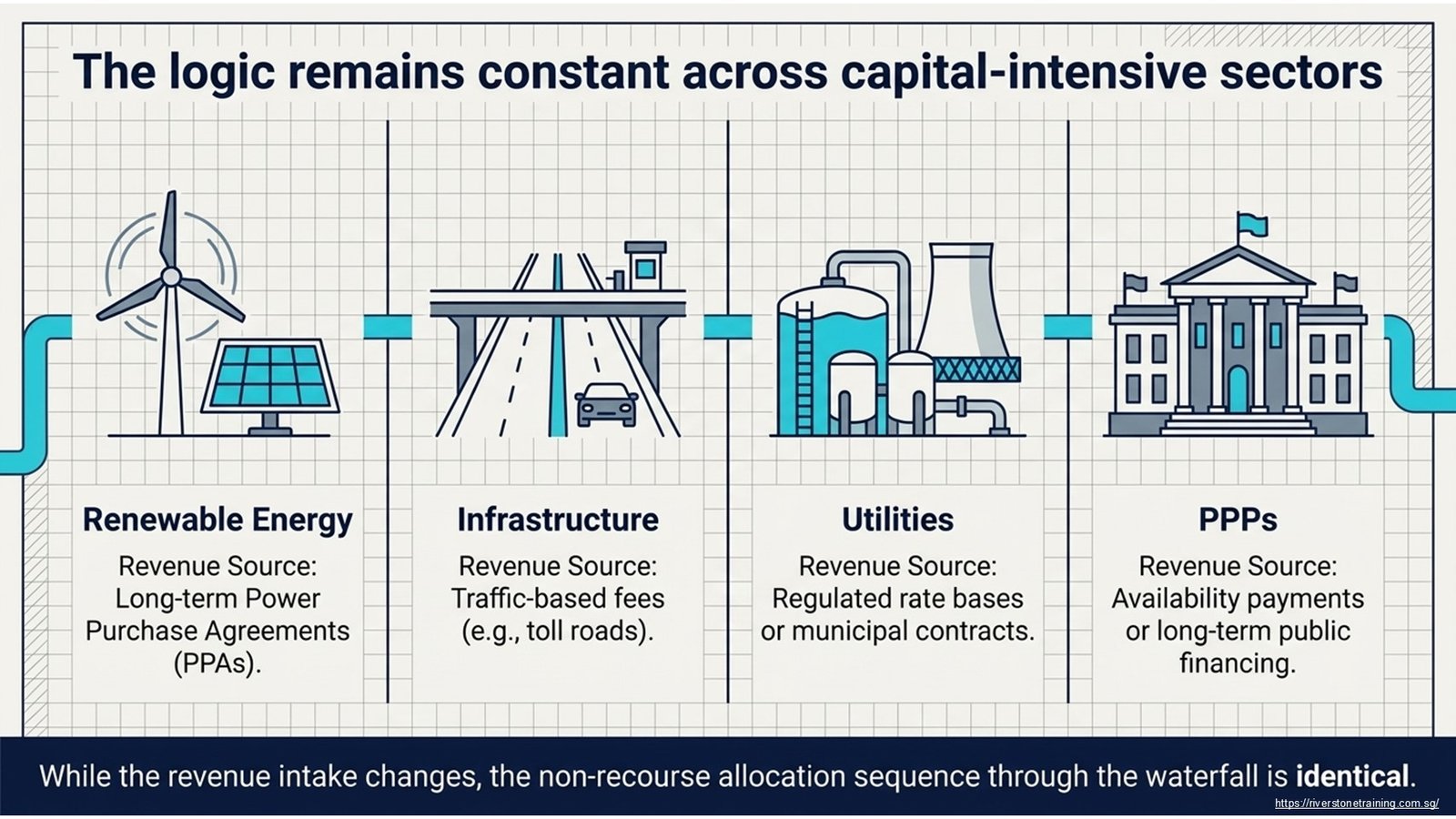
The cash flow waterfall model is a type that is applied to capital-intensive projects that are financed on a non-recourse or limited-recourse basis, such as renewable energy projects, transportation infrastructure projects, utilities, and public-private partnerships. The waterfall logic is the same across each sector, but modified based on their revenue structure and contractual obligations.
A solar farm, for example, would build its waterfall on the basis of the revenue from long-term power purchase agreements, while a toll road project would base its waterfall on the revenue generated from traffic-based fees. The following table lists some of the more common industries that use this modeling methodology.
Industry Applications Table
| Industry | Typical Use |
| Renewable Energy | Solar and wind projects |
| Infrastructure | Roads and railways |
| Utilities | Water and power plants |
| Public-Private Partnerships | Long-term infrastructure financing |
How Does Practical Excel Modeling Improve Financial Analysis?
Financial analysis is enhanced by the requirement to “model” the contractual and legal priorities in a working and testable structure, as opposed to a summary. Construction of the waterfall provides a chance to see the sensitivity of project results to changes in the revenue estimates, operating costs, or interest rates.
This hands-on method will also help an analyst’s capacity to perform scenario and sensitivity analysis, as a waterfall can be stress-tested by changing a few of the input cells. These are the very skills that lenders, sponsors and investment teams seek in candidates for jobs in infrastructure and energy finance.
Why Are Cash Flow Waterfalls Essential for Bankable Projects?
A bankable project is a project that the lender and investor will know will generate sufficient cash flow to service debt and meet operating expenses before the returns go to equity — and the model structure is the cash flow waterfall. Typically, projects that don’t provide a clean, well-supported waterfall find it difficult to get to financial close.
The waterfall approach makes it the point of reference for lenders, sponsors, and advisors during the process of due diligence and monitoring the projects throughout. In fact, good waterfall models are an essential prerequisite for financing infrastructure and renewable energy projects at scale.
Summary Table: Cash Flow Waterfall at a Glance
| Waterfall Tier | Modeling Focus |
| Operating Expenses | Forecast recurring operational costs |
| Debt Service | Calculate interest and principal by period |
| Reserve Accounts | Track and top up target reserve balances |
| Taxes | Apply statutory tax rates to project income |
| Equity Distributions | Release residual cash subject to distribution tests |
Conclusion
A cash flow waterfall is a system of distributing project revenues from one cash flow to another through a specific order: operating expenses, debt servicing, reserve accounts, taxes and equity distributions. It is this function that makes infrastructure and renewable energy projects profitable and agreeable to the lender.
Project finance modeling training online enables students to put into practice project finance modeling cash flow waterfall Excel skills in real infrastructure and energy deals, whereas project finance modeling cash flow waterfall Excel skills development provides the practical ability to construct, test, and analyze project finance models with accuracy. One of the most effective paths to long-term credibility in project finance is to reinforce this skill with structured training, a few practice sessions with Excel, and several business cases.