How Do Project Finance Models Help Identify and Manage Project Risks?

Project finance models enable the identification and management of project risks by running through various sets of conditions and testing how construction delays, revenue shortfalls and financing changes impact the viability of the project. Project finance model risk analysis involves the assessment of cash flow projections, scenarios and financing structures prior to investing to ensure that investment decisions are based on a solid, quantified knowledge of risk. 

What Is Project Finance Model Risk Analysis?

Project finance model risk analysis is the exercise of employing a structured financial model to identify, quantify and stress-test the risks that may impact a project’s ability to create cash flow and to repay debt. It integrates revenue, cost and financing variables in a single framework to provide analysts with a view of how the risk factors will interact, instead of being viewed in isolation.

This analysis is often completed at the same time as the construction budget, operating cost, offtake agreements and debt terms for infrastructure and energy projects. An effective model enables a lender or sponsor to track the impact of one change, like a late construction timeline, all the way to debt service coverage and equity returns. 

Why Is Risk Analysis Important in Project Finance?

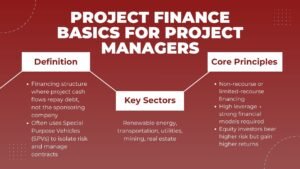
The rationale for risk analysis is that project finance is based on either non-recourse debt or limited-recourse debt, where the lender’s claim to be repaid is first met from the project’s own cash flows and secondly from the sponsor’s balance sheet. In the absence of sound risk assessment, lenders and investors cannot determine the ability of a project to manage cost overruns, market fluctuations or changes in regulation.

That’s why it’s important for the financier to do in-depth modeling before investing in a big energy, transportation or infrastructure initiative. A model for a toll road or a power plant, for instance, can rely only on the ability of projected cash flows to cover reasonable downside scenarios and still fulfill the debt obligations. 

What Types of Risks Are Evaluated in Project Finance Models?

The various types of risk taken into account by project finance models include construction risk, operational risk, market risk, and regulatory risk. Each category has an impact on a different aspect of the project’s cash flow profile, be it during the construction of the project or for decades over its operating life.

Construction risk is the risk associated with delays and cost overruns prior to commercial operation, whereas operational risk is the risk associated with performance during the asset’s operation. Market and regulatory risks are external risks that can affect revenue estimates after financial close, for example, changes in the market or changes in government policy. 

Risk Type Example
Construction Risk Delays and cost overruns during the build phase
Operational Risk Equipment failure or lower-than-expected output
Market Risk Lower-than-expected demand or price volatility
Regulatory Risk Changes in tariffs, permits, or environmental policy
Financing Risk Interest rate movements or refinancing shortfalls

How Do Financial Models Identify Project Risks?

Financial models are used to identify project risks as they are linked to all of the operational and financing assumptions and their corresponding calculated outputs, including annual cash flow, debt service coverage, and equity returns. The model will immediately reflect the changes made and show how those changes will impact the project’s financial position, thus uncovering vulnerabilities that would not be revealed in a static budget.

These connections are not incidental; rather, they are established by analysts, taking the costs of construction through to drawdown schedules and making linkages between revenue expectations and contract terms, including power purchase agreements or concession structures. This traceability makes a model an actual risk identification rather than a forecasting spreadsheet. 

How Does Scenario Analysis Improve Risk Assessment?

By varying the assumptions in the model, including an “upside” case, a “downside” case, and a “base case,” scenario analysis provides a clearer understanding of how project outcomes might change under different circumstances. This provides lenders and sponsors a better picture of the range of possible outcomes and not just a single, possibly misleading forecast.

An infrastructure project could have a six-month construction delay and a ten percent drop in the demand forecast. It’s important to see how debt service coverage performs with all of those combined stresses, and that tells the decision makers a lot more than any one assumption change would do by itself. 

How Does Sensitivity Analysis Support Better Decisions?

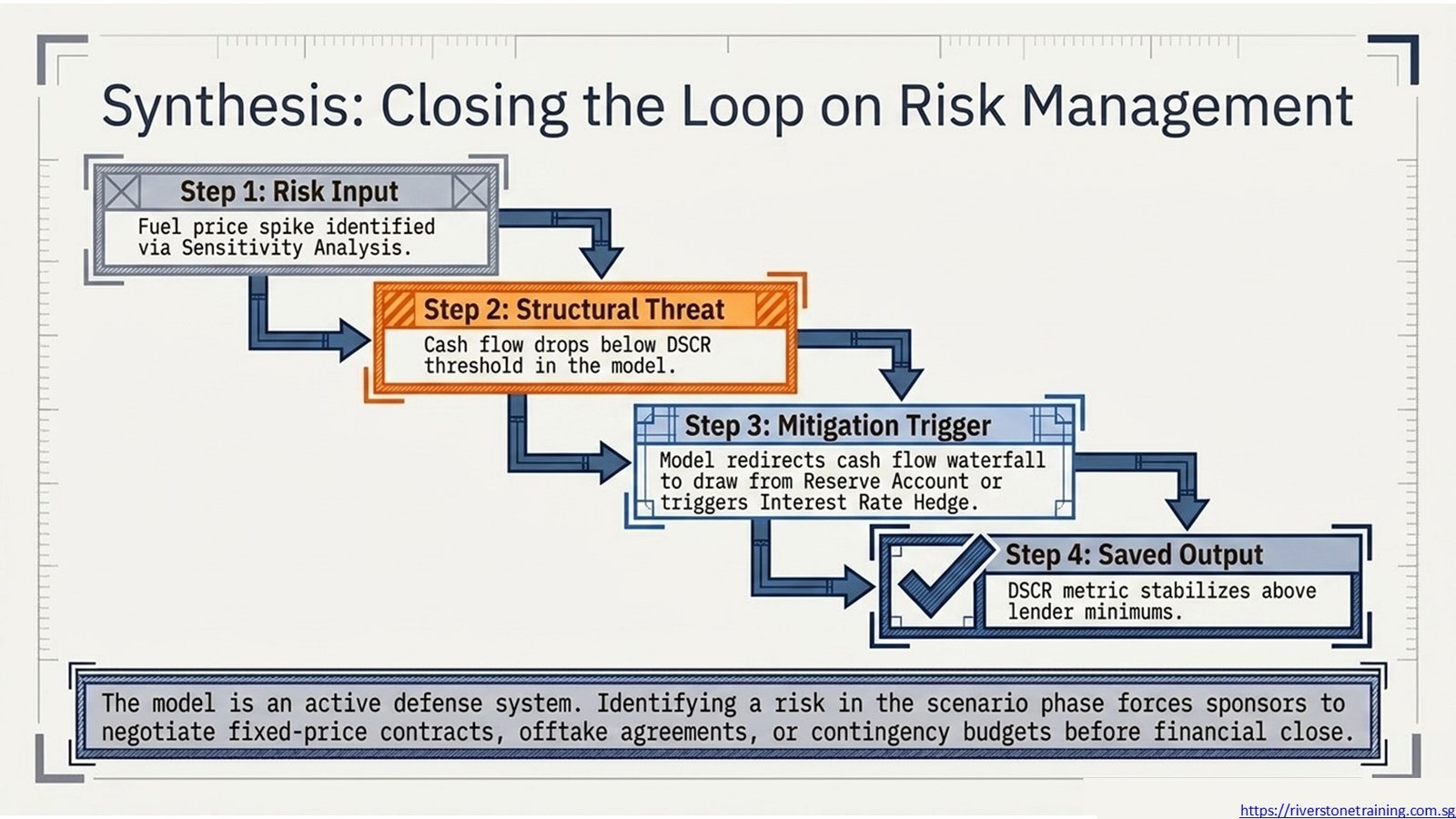
A sensitivity analysis can be used to make better decisions since it allows one variable to be changed at a time (for example, interest rates or construction costs) and determines how these changes affect project returns and debt coverage. This is helpful for analysts to get a handle on the most important assumptions so that due diligence and negotiation efforts can be concentrated in places where there is the greatest financial impact.

For energy projects, the sensitivity analysis may show that the risk from fuel prices and/or output levels are much higher than they are for the smaller project elements, such as insurance. Early recognition of this enables deal teams to focus on hedging strategies or contract terms that most effectively mitigate the sources of risk that are most material. 

How Does the Project Finance Debt Equity Structure Affect Project Risk?

Project finance debt equity structure influences project risk through its distribution of losses and returns between the lender and the sponsor, and therefore the amount of financial ‘safety net’ a project can have when it encounters a shock. The greater the amount of equity, the less risky it is for lenders, but the more costly it is for sponsors; the greater the amount of debt, the higher the leverage and the greater the repayment burden for sponsors. 

Understanding how to size and structure this balance is a core skill taught in project finance modeling courses, and an effective project finance debt equity structure balances financial risk, supports lender confidence, and improves the long-term bankability of infrastructure and capital-intensive projects.

How Are Cash Flow Risks Evaluated?

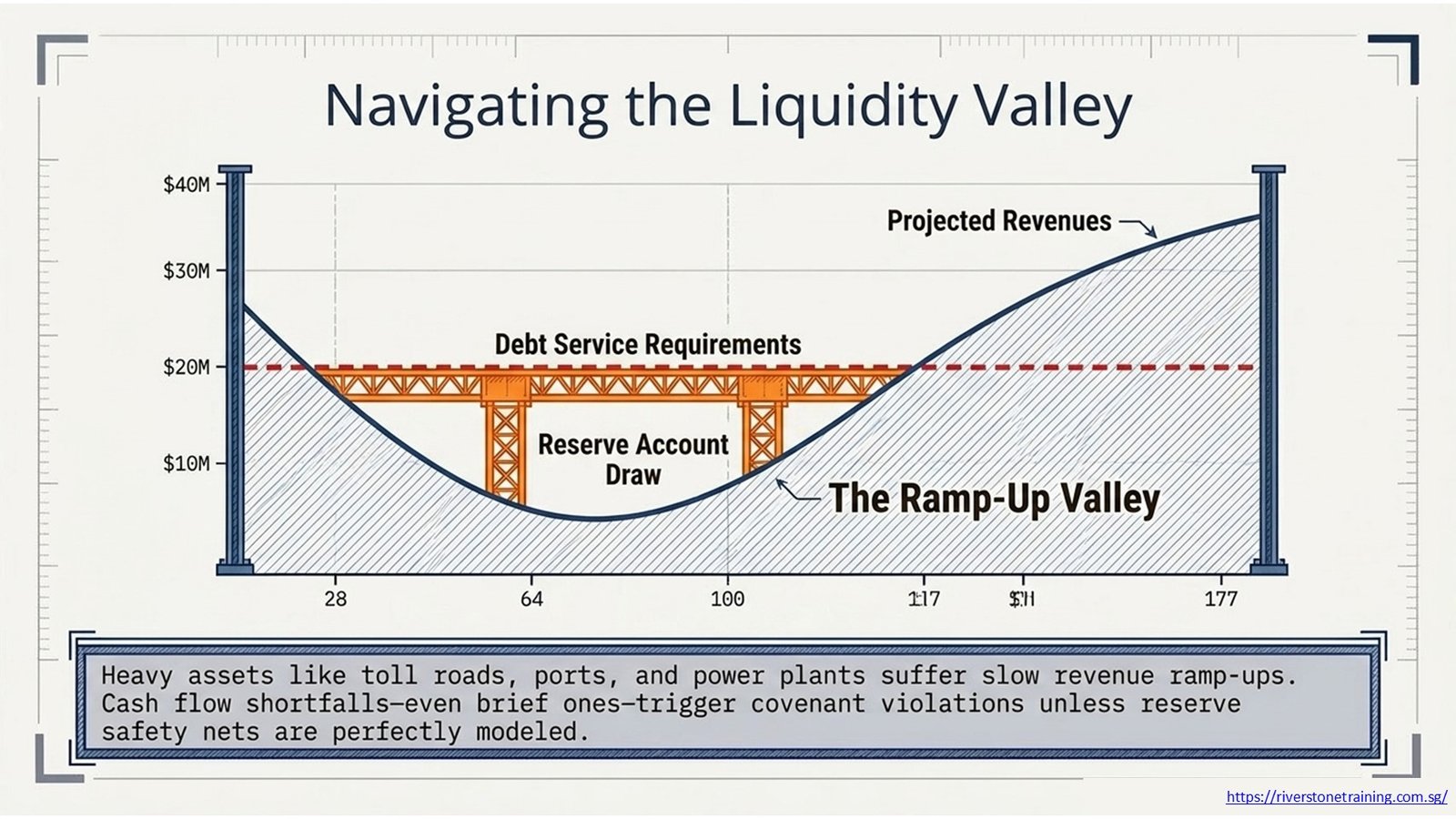
Cash flow risks are determined by projecting revenues and operating costs throughout the entire project, and then simulating what happens when both revenues and costs are low if projected debt service requirements are high or vice versa. Timing is critical to the analysts’ eyes because cash flow shortfalls, even for a short time, can mean a violation of the covenants or a draw on the reserve account.

Savory assets like toll roads, ports and power generation facilities are particularly vulnerable to cash flow timing, as revenue can often be slow to materialise once they start commercial operation. It is critical to accurately model this ramp-up period in order to avoid understating early-stage liquidity risk. 

How Do Lenders Assess Project Risks?

Debt service coverage ratio (DSCR) and loan life coverage ratio (LLCR) are the outputs of the financial model used to assess project risk, as they provide an idea of how well a project can pay back its loans. The minimum thresholds for DSCR are normally pre-established by the lender, and they will ask the model to show compliance under the downside scenarios outlined above.

In addition to these ratios, lenders will examine the underlying inputs to the model – such as contractual provisions, cost assumptions and market research. Even with reasonable stress testing, a model that doesn’t withstand it will have trouble getting favorable financing terms. 

How Do Sponsors Reduce Financial Risks?

Sponsors minimize financial risk by designing and negotiating contracts, insurance, and financing provisions to shift or limit specific risks that have been identified within the model. Typical methods to reduce the variability exhibited in scenario analysis are to use fixed-price construction contracts, long-term offtake agreements, and interest rate hedges.

There are also reserve accounts and contingency budgets built into the financing framework to accommodate short-term shocks without compromising on lender covenants. These mitigation strategies have to be explicitly represented in the model in order to measure and verify their financial impact, and this is why they are effective. 

What Financial Metrics Support Risk Evaluation?
Project Finance Models

Risk evaluation financial ratios that support include debt to equity ratio, internal rate of return (IRR), net present value (NPV), and the liquidity leverage ratio (LLCR). These metrics put a number on these cash flows in a standardized format that lenders, investors, and sponsors can use to compare the cash flow of various projects and financing options.

DSCR and LLCR are used to assess debt repayment capacity, while IRR and NPV are used to assess the value of a project and equity returns. All these metrics are displayed in a well-designed project finance model, enabling decision-makers to analyze the risk and return on a single model rather than separately. 

How Do Project Finance Modeling Courses Teach Risk Management?
Project Finance Models

Project finance modeling courses involve students constructing models from scratch, including construction budgets, financing structures and operating assumptions, and then using scenario and sensitivity analysis to real-life projects to illustrate the practice of risk management. This hands-on approach, often reinforced through a dedicated project finance model risk analysis module, builds the judgment needed to interpret model outputs rather than simply produce them.

Learners usually tackle case studies of infrastructure, energy, or transportation financing to determine the size of the financing, conduct covenant testing, and provide information to lenders or investment committees. The structured practice is similar to the actual work done by project finance analysts and infrastructure bankers. 

How Are Risk Models Used Throughout the Project Lifecycle?

Risk models are used during the project development lifecycle, from feasibility studies to financial close, construction, and throughout the operation of the project. Early-stage models are more about structuring and bankability; post-financing models are updated regularly to track actual performance against projections.

Up-to-date models have the potential to help sponsors and lenders monitor compliance with covenants and assess refinancing prospects when market conditions change while the loan is in operation. The continued use has given the impression that project finance modeling is a dynamic risk management process and not a static task. 

How Can Project Finance Modeling Skills Support Career Development?

Project finance modeling skills can also help advance career growth by giving professionals an advantage in being able to apply these skills to careers that demand the most demanding financial analysis in the middle of financial constraints, such as careers in Infrastructure Banking, Commercial Lending, and Corporate Development. They can be directly applied to the energy, transportation, and social infrastructure industries.

Having the ability to create, review and evaluate a project finance model on their own is a competency that employers appreciate in that it cuts down the investment process and makes it less dependent on external counsel. For many positions in finance at the analyst or associate level, a key differentiator is demonstrated modeling ability. 

Role Risk Modeling Application
Project Finance Analyst Evaluates investment risk and builds financing scenarios
Infrastructure Banker Assesses creditworthiness for lending decisions
Financial Modeler Runs scenario and sensitivity analysis on assumptions
Project Developer Tests feasibility before pursuing financing
Investment Analyst Compares risk-adjusted returns across projects

Why Is Professional Project Finance Training Important?

It is crucial to have professional project finance training as the creation of a stress-tested model involves more than just a good command of spreadsheet skills; it involves understanding the interplay of financing structures, contracts and market conditions throughout a project’s life cycle. Structured training helps this learning to go faster by using the case study method, instead of being learned through trial and error on the job.

Formal courses also introduce learners to industry norms for modeling, making it easier to work with lenders, advisors and investment committees that expect to work with models that have a recognized structure. A shared standard is one of the elements that makes a model credible and bankable for a competitive financing process. 

What Risk Analysis Techniques Are Most Commonly Applied?

Scenarios, sensitivities, stress testing and cash flow forecasting are the most widely used risk analysis methods, with each having its own specific function in the model. When used in combination, they provide a complete picture of the performance of a project in a variety of operating and financing scenarios.

Stress testing, for example, is used to consider all extreme but plausible combinations of risk: for example, how the project would perform if there was a simultaneous cost overrun and a revenue downturn, and determine whether the project would still have a minimum debt service requirement under such extreme scenarios. 

Technique Purpose
Scenario Analysis Evaluate multiple defined outcomes such as base, upside, and downside cases
Sensitivity Analysis Test the individual impact of key assumptions
Stress Testing Assess extreme but plausible combined scenarios
Cash Flow Forecasting Measure financial viability across the project timeline
Break-Even Analysis Identify the threshold at which a project stops covering costs

How Should Debt and Equity Risk Be Allocated in a Project?

Debt and equity risk should be assigned in a fashion where the lenders have protected and structured debt exposure with fixed repayment schedules, and the equity investors have higher variability of exposure to the risk and relatively higher returns. This allocation is a critical component of the project finance debt equity structure and affects the pricing of risks in the project financing.

Establishing this balance demands modeling various debt-to-equity ratios, keeping an eye on how each of these ratios affects the DSCR, LLCR and returns to the investor, and this type of analysis is practiced in abundance during project finance modeling training. 

Debt Financing Equity Financing
Fixed repayment obligations Higher investment risk exposure
Lower cost of capital Greater return potential
Requires lender approval and covenants Absorbs project losses first
Protected by security and reserve accounts Supports financial flexibility
Prioritized in the cash flow waterfall Subordinated to debt repayment

What Is the Practical Takeaway From Project Finance Model Risk Analysis?

The lesson to be learned is that project finance model risk analysis transforms project risk into financial results, which provides a common and quantified basis for the lender, sponsor and investor to make a decision. All techniques covered answer one question: will this project consistently generate returns of the financing in realistic conditions?

A summary table follows, combining the most important types of risks, the analytical methods and the financing aspects mentioned in this article. 

Focus Area Key Consideration
Risk Identification Construction, operational, market, and regulatory risks
Analytical Techniques Scenario analysis, sensitivity analysis, stress testing
Financing Structure Project finance debt equity structure and risk allocation
Key Metrics DSCR, LLCR, debt-to-equity ratio, IRR, NPV
Professional Application Career development in project and infrastructure finance

Conclusion

Project finance models are used to help define and control project risk by forecasting cash flows, structuring financing and performing scenario analysis and sensitivity analysis to assess the performance of a project in realistic and stressed situations. These methods can be reinforced by disciplined risk mitigation approaches, leading to better investment choices and project bankability over time. Project finance model risk analysis expertise helps to navigate the uncertainties of financing with greater confidence, and a good knowledge of project finance debt-equity structure helps to fine-tune funding strategies and bolster the financial strength of infrastructure projects.

Anyone wishing to further develop these skills should seek structured, hands-on training that incorporates modelling techniques and real case studies, as the key to making financial judgements in the workplace is repetition. 

Frequently Asked Questions

What is project finance model risk analysis?

Project finance model risk analysis is the process of identifying, quantifying, and testing the effects of construction, operating, market, and regulatory risks on the cash flow and ability to repay the debt of a project using a financial model. It provides a well defined and number-based framework for the investment and financing decisions of lenders and sponsors.

The significance of risk analysis is that the project finance debt is paid back mainly from project cash flows, not from the sponsor’s balance sheet. Lenders and investors need to be able to make an informed decision on the feasibility of the project with respect to potential cost overruns or demand deficits and regulatory shifts during the duration of financing. 

With scenario analysis, the project risk is minimized by simulating the effects of interactions between various project assumptions, such as reduced demand coupled with construction delays, on debt service coverage and equity returns. This will highlight the issues that a sole base case forecast would not show and risks can be mitigated before financial close. 

Debt-equity structure is a critical aspect to project finance in that it will dictate the manner in which losses and returns are shared between lenders and sponsors. This balance is important in a project’s risk profile, with higher equity ratios generally resulting in reduced default risk and higher leverage ratios in greater repayment pressures. 

Project finance modelling skills are required for careers such as Project finance analyst, Infrastructure banker, Commercial lender, Financial modeler and Project developer. All of these roles require the capacity to develop, analyse and test financial models, to support financing and investment decisions. 

A project finance model is dynamic and needs to be updated whenever there is a change in material assumptions and should be reviewed regularly during the construction and operations phase, in order to track the compliance of the covenants. Several sponsors and lenders adjust models quarterly or annually as a result of the actual experience versus initial projections. 

Project finance models enable the identification and management of project risks by running through various sets of conditions and testing how construction delays, revenue shortfalls and financing changes impact the viability of the project. Project finance model risk analysis involves the assessment of cash flow projections, scenarios and financing structures prior to investing to ensure that investment decisions are based on a solid, quantified knowledge of risk. 

What Is Project Finance Model Risk Analysis?

Project finance model risk analysis is the exercise of employing a structured financial model to identify, quantify and stress-test the risks that may impact a project’s ability to create cash flow and to repay debt. It integrates revenue, cost and financing variables in a single framework to provide analysts with a view of how the risk factors will interact, instead of being viewed in isolation.

This analysis is often completed at the same time as the construction budget, operating cost, offtake agreements and debt terms for infrastructure and energy projects. An effective model enables a lender or sponsor to track the impact of one change, like a late construction timeline, all the way to debt service coverage and equity returns. 

Why Is Risk Analysis Important in Project Finance?

The rationale for risk analysis is that project finance is based on either non-recourse debt or limited-recourse debt, where the lender’s claim to be repaid is first met from the project’s own cash flows and secondly from the sponsor’s balance sheet. In the absence of sound risk assessment, lenders and investors cannot determine the ability of a project to manage cost overruns, market fluctuations or changes in regulation.

That’s why it’s important for the financier to do in-depth modeling before investing in a big energy, transportation or infrastructure initiative. A model for a toll road or a power plant, for instance, can rely only on the ability of projected cash flows to cover reasonable downside scenarios and still fulfill the debt obligations. 

What Types of Risks Are Evaluated in Project Finance Models?

The various types of risk taken into account by project finance models include construction risk, operational risk, market risk, and regulatory risk. Each category has an impact on a different aspect of the project’s cash flow profile, be it during the construction of the project or for decades over its operating life.

Construction risk is the risk associated with delays and cost overruns prior to commercial operation, whereas operational risk is the risk associated with performance during the asset’s operation. Market and regulatory risks are external risks that can affect revenue estimates after financial close, for example, changes in the market or changes in government policy. 

Risk Type Example
Construction Risk Delays and cost overruns during the build phase
Operational Risk Equipment failure or lower-than-expected output
Market Risk Lower-than-expected demand or price volatility
Regulatory Risk Changes in tariffs, permits, or environmental policy
Financing Risk Interest rate movements or refinancing shortfalls

How Do Financial Models Identify Project Risks?

Financial models are used to identify project risks as they are linked to all of the operational and financing assumptions and their corresponding calculated outputs, including annual cash flow, debt service coverage, and equity returns. The model will immediately reflect the changes made and show how those changes will impact the project’s financial position, thus uncovering vulnerabilities that would not be revealed in a static budget.

These connections are not incidental; rather, they are established by analysts, taking the costs of construction through to drawdown schedules and making linkages between revenue expectations and contract terms, including power purchase agreements or concession structures. This traceability makes a model an actual risk identification rather than a forecasting spreadsheet. 

How Does Scenario Analysis Improve Risk Assessment?

By varying the assumptions in the model, including an “upside” case, a “downside” case, and a “base case,” scenario analysis provides a clearer understanding of how project outcomes might change under different circumstances. This provides lenders and sponsors a better picture of the range of possible outcomes and not just a single, possibly misleading forecast.

An infrastructure project could have a six-month construction delay and a ten percent drop in the demand forecast. It’s important to see how debt service coverage performs with all of those combined stresses, and that tells the decision makers a lot more than any one assumption change would do by itself. 

How Does Sensitivity Analysis Support Better Decisions?

A sensitivity analysis can be used to make better decisions since it allows one variable to be changed at a time (for example, interest rates or construction costs) and determines how these changes affect project returns and debt coverage. This is helpful for analysts to get a handle on the most important assumptions so that due diligence and negotiation efforts can be concentrated in places where there is the greatest financial impact.

For energy projects, the sensitivity analysis may show that the risk from fuel prices and/or output levels are much higher than they are for the smaller project elements, such as insurance. Early recognition of this enables deal teams to focus on hedging strategies or contract terms that most effectively mitigate the sources of risk that are most material. 

How Does the Project Finance Debt Equity Structure Affect Project Risk?

Project finance debt equity structure influences project risk through its distribution of losses and returns between the lender and the sponsor, and therefore the amount of financial ‘safety net’ a project can have when it encounters a shock. The greater the amount of equity, the less risky it is for lenders, but the more costly it is for sponsors; the greater the amount of debt, the higher the leverage and the greater the repayment burden for sponsors. 

Understanding how to size and structure this balance is a core skill taught in project finance modeling courses, and an effective project finance debt equity structure balances financial risk, supports lender confidence, and improves the long-term bankability of infrastructure and capital-intensive projects.

How Are Cash Flow Risks Evaluated?

Cash flow risks are determined by projecting revenues and operating costs throughout the entire project, and then simulating what happens when both revenues and costs are low if projected debt service requirements are high or vice versa. Timing is critical to the analysts’ eyes because cash flow shortfalls, even for a short time, can mean a violation of the covenants or a draw on the reserve account.

Savory assets like toll roads, ports and power generation facilities are particularly vulnerable to cash flow timing, as revenue can often be slow to materialise once they start commercial operation. It is critical to accurately model this ramp-up period in order to avoid understating early-stage liquidity risk. 

How Do Lenders Assess Project Risks?

Debt service coverage ratio (DSCR) and loan life coverage ratio (LLCR) are the outputs of the financial model used to assess project risk, as they provide an idea of how well a project can pay back its loans. The minimum thresholds for DSCR are normally pre-established by the lender, and they will ask the model to show compliance under the downside scenarios outlined above.

In addition to these ratios, lenders will examine the underlying inputs to the model – such as contractual provisions, cost assumptions and market research. Even with reasonable stress testing, a model that doesn’t withstand it will have trouble getting favorable financing terms. 

How Do Sponsors Reduce Financial Risks?

Sponsors minimize financial risk by designing and negotiating contracts, insurance, and financing provisions to shift or limit specific risks that have been identified within the model. Typical methods to reduce the variability exhibited in scenario analysis are to use fixed-price construction contracts, long-term offtake agreements, and interest rate hedges.

There are also reserve accounts and contingency budgets built into the financing framework to accommodate short-term shocks without compromising on lender covenants. These mitigation strategies have to be explicitly represented in the model in order to measure and verify their financial impact, and this is why they are effective. 

What Financial Metrics Support Risk Evaluation?

Project Finance Models

Risk evaluation financial ratios that support include debt to equity ratio, internal rate of return (IRR), net present value (NPV), and the liquidity leverage ratio (LLCR). These metrics put a number on these cash flows in a standardized format that lenders, investors, and sponsors can use to compare the cash flow of various projects and financing options.

DSCR and LLCR are used to assess debt repayment capacity, while IRR and NPV are used to assess the value of a project and equity returns. All these metrics are displayed in a well-designed project finance model, enabling decision-makers to analyze the risk and return on a single model rather than separately. 

How Do Project Finance Modeling Courses Teach Risk Management?

Project Finance Models

Project finance modeling courses involve students constructing models from scratch, including construction budgets, financing structures and operating assumptions, and then using scenario and sensitivity analysis to real-life projects to illustrate the practice of risk management. This hands-on approach, often reinforced through a dedicated project finance model risk analysis module, builds the judgment needed to interpret model outputs rather than simply produce them.

Learners usually tackle case studies of infrastructure, energy, or transportation financing to determine the size of the financing, conduct covenant testing, and provide information to lenders or investment committees. The structured practice is similar to the actual work done by project finance analysts and infrastructure bankers. 

How Are Risk Models Used Throughout the Project Lifecycle?

Risk models are used during the project development lifecycle, from feasibility studies to financial close, construction, and throughout the operation of the project. Early-stage models are more about structuring and bankability; post-financing models are updated regularly to track actual performance against projections.

Up-to-date models have the potential to help sponsors and lenders monitor compliance with covenants and assess refinancing prospects when market conditions change while the loan is in operation. The continued use has given the impression that project finance modeling is a dynamic risk management process and not a static task. 

How Can Project Finance Modeling Skills Support Career Development?

Project finance modeling skills can also help advance career growth by giving professionals an advantage in being able to apply these skills to careers that demand the most demanding financial analysis in the middle of financial constraints, such as careers in Infrastructure Banking, Commercial Lending, and Corporate Development. They can be directly applied to the energy, transportation, and social infrastructure industries.

Having the ability to create, review and evaluate a project finance model on their own is a competency that employers appreciate in that it cuts down the investment process and makes it less dependent on external counsel. For many positions in finance at the analyst or associate level, a key differentiator is demonstrated modeling ability. 

Role Risk Modeling Application
Project Finance Analyst Evaluates investment risk and builds financing scenarios
Infrastructure Banker Assesses creditworthiness for lending decisions
Financial Modeler Runs scenario and sensitivity analysis on assumptions
Project Developer Tests feasibility before pursuing financing
Investment Analyst Compares risk-adjusted returns across projects

Why Is Professional Project Finance Training Important?

It is crucial to have professional project finance training as the creation of a stress-tested model involves more than just a good command of spreadsheet skills; it involves understanding the interplay of financing structures, contracts and market conditions throughout a project’s life cycle. Structured training helps this learning to go faster by using the case study method, instead of being learned through trial and error on the job.

Formal courses also introduce learners to industry norms for modeling, making it easier to work with lenders, advisors and investment committees that expect to work with models that have a recognized structure. A shared standard is one of the elements that makes a model credible and bankable for a competitive financing process. 

What Risk Analysis Techniques Are Most Commonly Applied?

Scenarios, sensitivities, stress testing and cash flow forecasting are the most widely used risk analysis methods, with each having its own specific function in the model. When used in combination, they provide a complete picture of the performance of a project in a variety of operating and financing scenarios.

Stress testing, for example, is used to consider all extreme but plausible combinations of risk: for example, how the project would perform if there was a simultaneous cost overrun and a revenue downturn, and determine whether the project would still have a minimum debt service requirement under such extreme scenarios. 

Technique Purpose
Scenario Analysis Evaluate multiple defined outcomes such as base, upside, and downside cases
Sensitivity Analysis Test the individual impact of key assumptions
Stress Testing Assess extreme but plausible combined scenarios
Cash Flow Forecasting Measure financial viability across the project timeline
Break-Even Analysis Identify the threshold at which a project stops covering costs

How Should Debt and Equity Risk Be Allocated in a Project?

Debt and equity risk should be assigned in a fashion where the lenders have protected and structured debt exposure with fixed repayment schedules, and the equity investors have higher variability of exposure to the risk and relatively higher returns. This allocation is a critical component of the project finance debt equity structure and affects the pricing of risks in the project financing.

Establishing this balance demands modeling various debt-to-equity ratios, keeping an eye on how each of these ratios affects the DSCR, LLCR and returns to the investor, and this type of analysis is practiced in abundance during project finance modeling training. 

Debt Financing Equity Financing
Fixed repayment obligations Higher investment risk exposure
Lower cost of capital Greater return potential
Requires lender approval and covenants Absorbs project losses first
Protected by security and reserve accounts Supports financial flexibility
Prioritized in the cash flow waterfall Subordinated to debt repayment

What Is the Practical Takeaway From Project Finance Model Risk Analysis?

The lesson to be learned is that project finance model risk analysis transforms project risk into financial results, which provides a common and quantified basis for the lender, sponsor and investor to make a decision. All techniques covered answer one question: will this project consistently generate returns of the financing in realistic conditions?

A summary table follows, combining the most important types of risks, the analytical methods and the financing aspects mentioned in this article. 

Focus Area Key Consideration
Risk Identification Construction, operational, market, and regulatory risks
Analytical Techniques Scenario analysis, sensitivity analysis, stress testing
Financing Structure Project finance debt equity structure and risk allocation
Key Metrics DSCR, LLCR, debt-to-equity ratio, IRR, NPV
Professional Application Career development in project and infrastructure finance

Conclusion

Project finance models are used to help define and control project risk by forecasting cash flows, structuring financing and performing scenario analysis and sensitivity analysis to assess the performance of a project in realistic and stressed situations. These methods can be reinforced by disciplined risk mitigation approaches, leading to better investment choices and project bankability over time. Project finance model risk analysis expertise helps to navigate the uncertainties of financing with greater confidence, and a good knowledge of project finance debt-equity structure helps to fine-tune funding strategies and bolster the financial strength of infrastructure projects.

Anyone wishing to further develop these skills should seek structured, hands-on training that incorporates modelling techniques and real case studies, as the key to making financial judgements in the workplace is repetition. 
Frequently Asked Questions

What is project finance model risk analysis?

Project finance model risk analysis is the process of identifying, quantifying, and testing the effects of construction, operating, market, and regulatory risks on the cash flow and ability to repay the debt of a project using a financial model. It provides a well defined and number-based framework for the investment and financing decisions of lenders and sponsors.

The significance of risk analysis is that the project finance debt is paid back mainly from project cash flows, not from the sponsor’s balance sheet. Lenders and investors need to be able to make an informed decision on the feasibility of the project with respect to potential cost overruns or demand deficits and regulatory shifts during the duration of financing. 

With scenario analysis, the project risk is minimized by simulating the effects of interactions between various project assumptions, such as reduced demand coupled with construction delays, on debt service coverage and equity returns. This will highlight the issues that a sole base case forecast would not show and risks can be mitigated before financial close. 

Debt-equity structure is a critical aspect to project finance in that it will dictate the manner in which losses and returns are shared between lenders and sponsors. This balance is important in a project’s risk profile, with higher equity ratios generally resulting in reduced default risk and higher leverage ratios in greater repayment pressures. 

Project finance modelling skills are required for careers such as Project finance analyst, Infrastructure banker, Commercial lender, Financial modeler and Project developer. All of these roles require the capacity to develop, analyse and test financial models, to support financing and investment decisions. 

A project finance model is dynamic and needs to be updated whenever there is a change in material assumptions and should be reviewed regularly during the construction and operations phase, in order to track the compliance of the covenants. Several sponsors and lenders adjust models quarterly or annually as a result of the actual experience versus initial projections. 

Related Posts

Everything You Need to Know About Project Financial Modeling Courses

Contact Riverstone Training today to explore our specialized project financial modeling courses designed for professionals and teams.