
The purpose of project finance models is to help make decisions about infrastructure investment by simulating cash flows and assessing project risks, testing financing structures, and evaluating long-term financial viability without committing any capital. An infrastructure professional project finance model provides a well-structured framework for analysts, lenders, and investors to approve, reject, or restructure huge infrastructure projects.
What Is Project Finance Modeling for Infrastructure?
Project finance modeling for infrastructure: The creation of a financial model to forecast a project’s income, expenses, and funding for the duration of its operational life. It brings together building expenses, operating expenses, and debt repayments under one roof to help determine if the project will produce sufficient cash flow to service the lender and provide returns to the investor.
An infrastructure project finance model differs from corporate finance by focusing on a single asset—like a toll road, power plant, or solar farm—and financing is secured largely based on that asset’s future cash-generating ability. This particular structure demands that analysts forecast capital expenditure, operating expenditure, and revenue with a greater level of accuracy than a regular corporate forecast.
Why Are Project Finance Models Important for Infrastructure Investments?
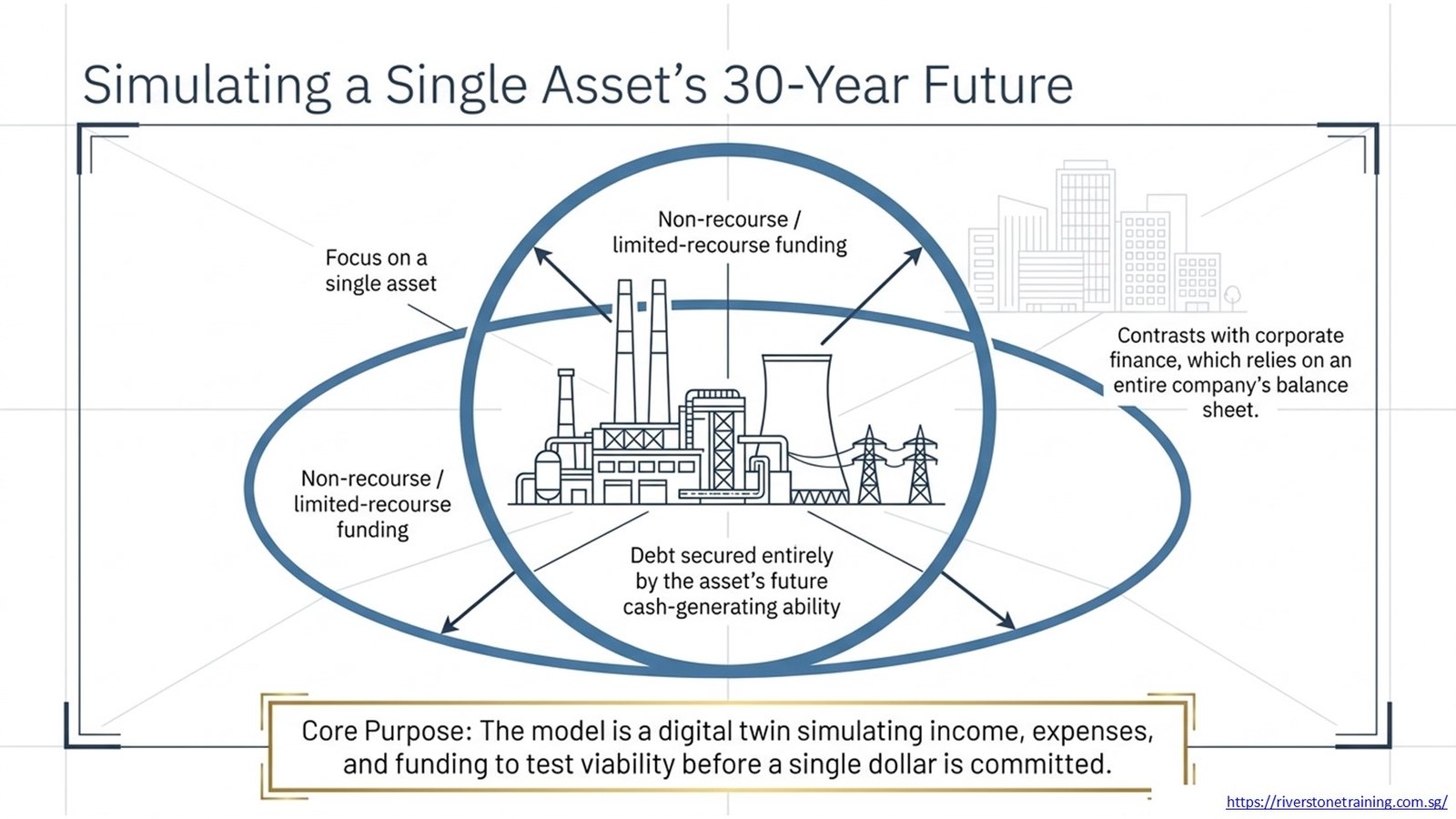
Project finance models are important because infrastructure investments require significant initial investment, long-term payback, and multiple stakeholders who must independently verify project viability. A solid structure enables the lender, sponsors, and government agencies to run the scenarios before entering into binding financing arrangements.
Small changes in the assumptions have a significant magnifying effect over the 20-30 year lifetimes of toll facilities, airports and power plants. These long-term impacts can be captured in financial models early and minimise downstream capital commitments to an investment that may not be economically viable.
How Are Project Cash Flows Forecasted?
Cash flows are projected by developing a full schedule of projected construction costs, operating revenues, operating expenses, taxes, and debt service for the entire Life Cycle of the project. During the construction period, cash outflows are very high, so typically analysts break it out separately from the operating period where the project should begin generating positive free cash flow.
Typically, revenue assumptions are tied to the terms of contracts like power purchase agreements, or terms for toll concessions, and cost assumptions are based on engineering estimates and operating records of similar assets. The cash flow forecasting process itself is a fundamental skill learned in infrastructure project finance training.
How Do Financial Models Evaluate Project Feasibility?
The feasibility analysis is performed using financial models to see if proposed cash flows will cover operating costs, debt service, and a desired return to equity investors. First, the analyst looks at the project’s NPV, IRR, and coverage ratios for a base case set of assumptions and then considers more stressed scenarios.
A project is considered feasible if reasonable adjustments to the construction costs, forecast of demand, or interest rate do not make the return or coverage ratios negative. This feasibility testing directly feeds into the go or no-go investment decisions for infrastructure proposals by their sponsors, lenders, and public authorities.
How Are Debt and Equity Structures Analyzed?
Debt and equity structures involve calculating a project’s cash flow sufficient to support senior debt, referred to as debt sizing, and the amount of remaining capital to be provided by equity or subordinated structures. Various debt-to-equity ratios are used by analysts to determine the impact of leveraging on risk and returns to investors.
The model also explores repayment profiles such as grace periods for building, amortization profiles, and when interest is paid. The structuring decisions have a significant impact on the debt service coverage ratio of a project and influence the negotiating stance of the sponsors versus the lender.
Why Is Risk Analysis Essential in Infrastructure Projects?
The fact that infrastructure projects are subject to construction delays, demand uncertainty, interest rate fluctuations, and regulatory changes, which can have a significant impact on financial performance, makes risk analysis essential. A financial model is a structured method of estimating the impact that each risk factor has on the project returns and its ability to repay its debt.
Another key element of project finance structuring is the allocation of risk; lenders usually wish to have construction, operating and market risk assigned to the most appropriate entities. Financial models are used to estimate the financial consequences that may develop as a result of various risk allocation agreements before contracts are agreed.
How Do Scenario and Sensitivity Analyses Improve Investment Decisions?
Scenario and sensitivity analyses provide a detailed understanding of how variations in selected project parameters (including construction cost overruns or reduced demand) will impact project returns and debt coverage. Analysts generally develop an upside, base, and downside scenario to be aware of all the possible outcomes.
Sensitivity analysis helps to isolate the effect of each variable, such as interest rates or operating costs, so that analysts can determine which assumptions affect the project’s viability the most. It is a very useful analytical skill that is emphasized during project finance modeling coursework.
How Is Project Finance Modeling Applied to Solar Energy Projects?
Project finance modelling for solar energy uses the same fundamental concepts that are found in all project finance modelling—cash flow forecasting, sizing the debt, and risk analysis—but tailored to the specific nature of renewable energy assets. Solar projects require detailed modeling of energy yield, panel degradation rates, and long-term power purchase agreement pricing, as illustrated in this practical case study on renewable energy project finance modeling.
Solar projects are usually “take or pay” offtake contracts, which makes them very predictable in terms of cash flow, but there remains the need to test the sensitivity to variation in the sun’s irradiance, maintenance costs, and refinancing risk. It means that understanding these variables in renewable energy and learning how to model them will enable analysts to move with confidence within the conventional and clean energy industries.
What Financial Metrics Support Infrastructure Investment Decisions?
These financial indicators include net present value, internal rate of return, debt service coverage ratio, and loan life coverage ratio, which provide a common language for comparing infrastructure opportunities for both lenders and investors. Each of the metrics responds to a different question, whether it is the total value of the project or whether it can service the debt for a particular time period.
There is no single metric; they are used collectively. Generally, lenders are more concerned about coverage ratios to evaluate repayment risk, while equity investors are more concerned about the internal rate of return and net present value attributes when considering infrastructure investments versus other investments of capital.
| Metric | Purpose |
| Net Present Value (NPV) | Measures the discounted value the project creates for investors |
| Internal Rate of Return (IRR) | Evaluates the annualized return generated by the investment |
| Debt Service Coverage Ratio (DSCR) | Assesses the project’s capacity to repay debt in each period |
| Loan Life Coverage Ratio (LLCR) | Measures coverage across the full remaining term of the loan |
How Do Lenders Use Project Finance Models?
Project finance models are used to size debt to a project and generally consist of calculating the amount of debt a project can afford, usually by calculating the minimum debt service coverage ratio on a project loan throughout the loan term. The model also assists lenders in structuring covenants, reserve accounts, and repayment plans that ensure that lenders’ best interests are safeguarded if performance is less than what is expected.
In the event of project finance, it is very important to the lenders that the underlying cash flow model is strong, as it is non-recourse or limited-recourse to the sponsors. Thus, it is essential to have accurate and well-documented modelling in infrastructure lending transactions that is part of the application process.
How Do Investors Evaluate Infrastructure Projects?
Investors assess infrastructure investments based on expected equity return, payback, and how this return changes with respect to risks of construction, market, and regulations. A financial model is a tool that enables an investor to evaluate an infrastructure opportunity on a level playing field with other investments, based on risk-adjusted returns.
Public-private partnerships add a layer of complexity as investors need to consider concession terms, government support mechanisms and contractual risk-sharing arrangements, too. These contractual specifics are then translated into quantitative expectations of return that are used to drive disciplined investment decisions through financial models.
What Practical Skills Are Developed in Project Finance Modeling Courses?
Project finance modeling courses build the hands-on skills to create infrastructure financial models from scratch, such as cash flow forecasting, debt size, and financing structure analysis. Learners in a project finance modeling for infrastructure course work through real infrastructure case studies to strengthen both technical modeling accuracy and investment judgment.
In addition to spreadsheet skills, these courses develop the skills to understand the results of the models, to share results with lenders and investment committees, and to use scenario analysis in making investment decisions. These are the same skills that project finance analysts, investment bankers and infrastructure consultants use regularly in their work.
How Are Project Finance Models Used Throughout the Project Lifecycle?
Project finance models are utilized at various stages of the project, from the feasibility stage to financial close, construction, and from the point of full operation on a continuous basis, and the model is constantly updated as actual data become available, replacing early assumptions. The model will record drawdowns and cost performance during construction and then record actual DSCR during operations compared with projections.
This lifecycle use implies that the model is not a single-shot kind of affair. It is constantly dug up by analysts and lenders for refinancing purposes, compliance of covenants, and ultimately the sale of the asset and contract negotiation.
How Can Project Finance Modeling Support Career Development?
Project finance modeling is an important skill for finance practitioners, which can also be used to develop a career in banking, infrastructure advisory, and investment banking. Financial models of infrastructure are a key skill for analysts who can develop and understand them and who are suited to work on project finance teams, commercial banking teams, and infrastructure investment teams.
Governments and private investors keep investing in infrastructure and renewable energy projects, putting an increasing demand on professionals to be able to confidently model project cash flow and financing structures, both in developed and emerging markets.
| Role | Project Finance Modeling Application |
| Project Finance Analyst | Builds and maintains infrastructure investment models |
| Investment Banker | Structures financing and advises on project transactions |
| Commercial Banker | Assesses credit risk and debt repayment capacity |
| Infrastructure Consultant | Evaluates project feasibility for sponsors and agencies |
| Financial Modeling Analyst | Supports scenario and sensitivity analysis for investment teams |
Why Is Professional Project Finance Training Important?
A critical reason why professional project finance training is necessary is that the financial models used for infrastructure must be technically correct, internally consistent and defensible with respect to lenders, investors and auditors. Structured training minimises the errors and inconsistent assumptions that are often found in self-taught or ad hoc models.
Real infrastructure and renewable energy case studies are also used for training, which helps the learner to see that the choices made during the modeling process relate to financing results, and are not just an academic exercise. This “street-smart” understanding sets apart job-ready project finance analysts from those with just theory.
How Does the Infrastructure Investment Evaluation Process Work?
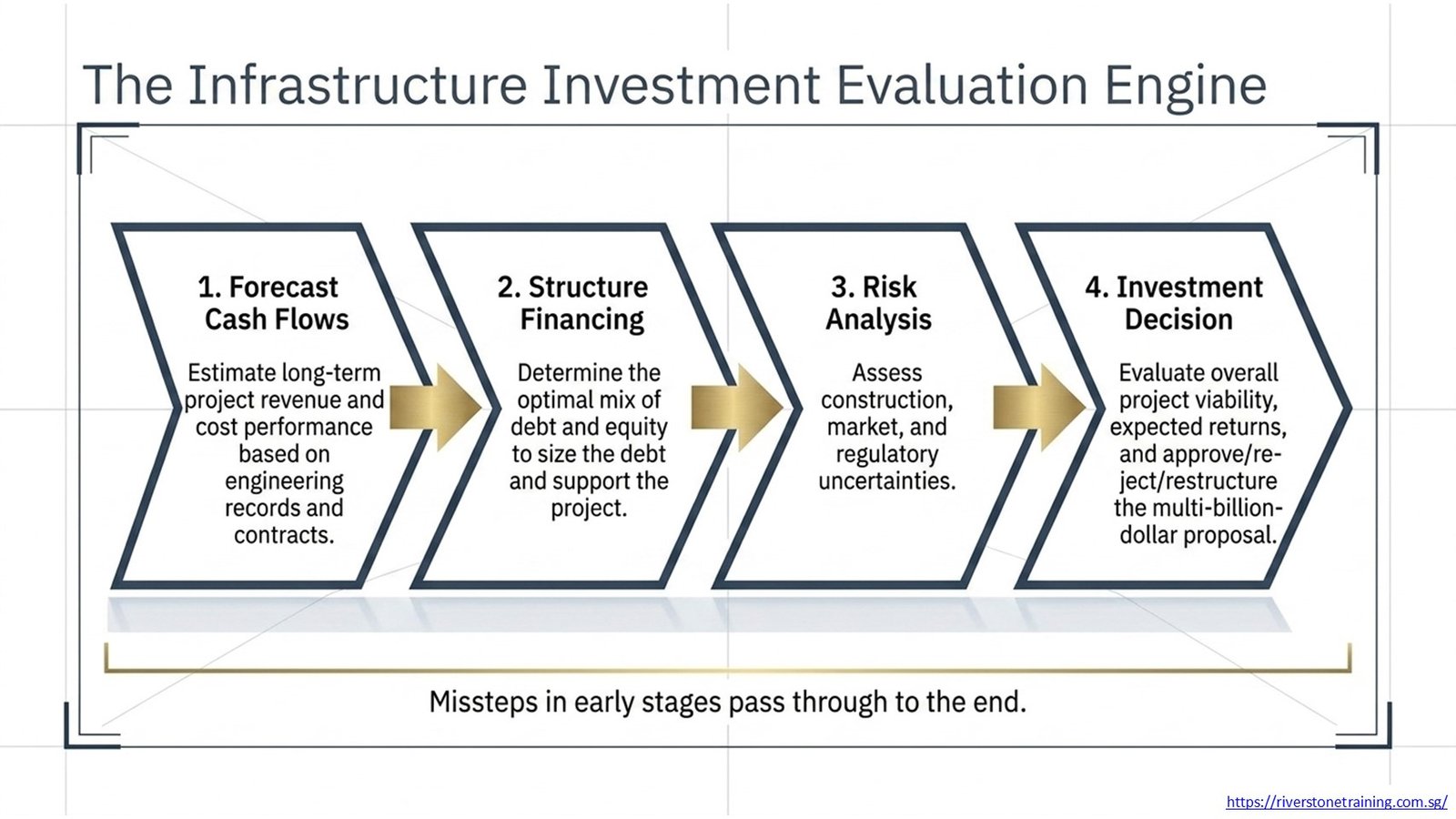
The infrastructure investment appraisal process follows the same stages of forecasting cash flows, structuring financing, risk analysis, and investment decision. The stages are dependent on each other; missteps in the initial cash flow assumptions are passed through to financing and risk determination.
This approach enables lenders, sponsors, and public agencies to compare infrastructure opportunities across a range of sectors and geographic areas. The following table provides an overview of each phase of this evaluation.
| Stage | Purpose |
| Forecast Cash Flows | Estimate long-term project revenue and cost performance |
| Structure Financing | Determine the optimal mix of debt and equity |
| Risk Analysis | Assess construction, market, and regulatory uncertainties |
| Investment Decision | Evaluate overall project viability and expected returns |
What Are Common Infrastructure Project Risks and Mitigation Strategies?
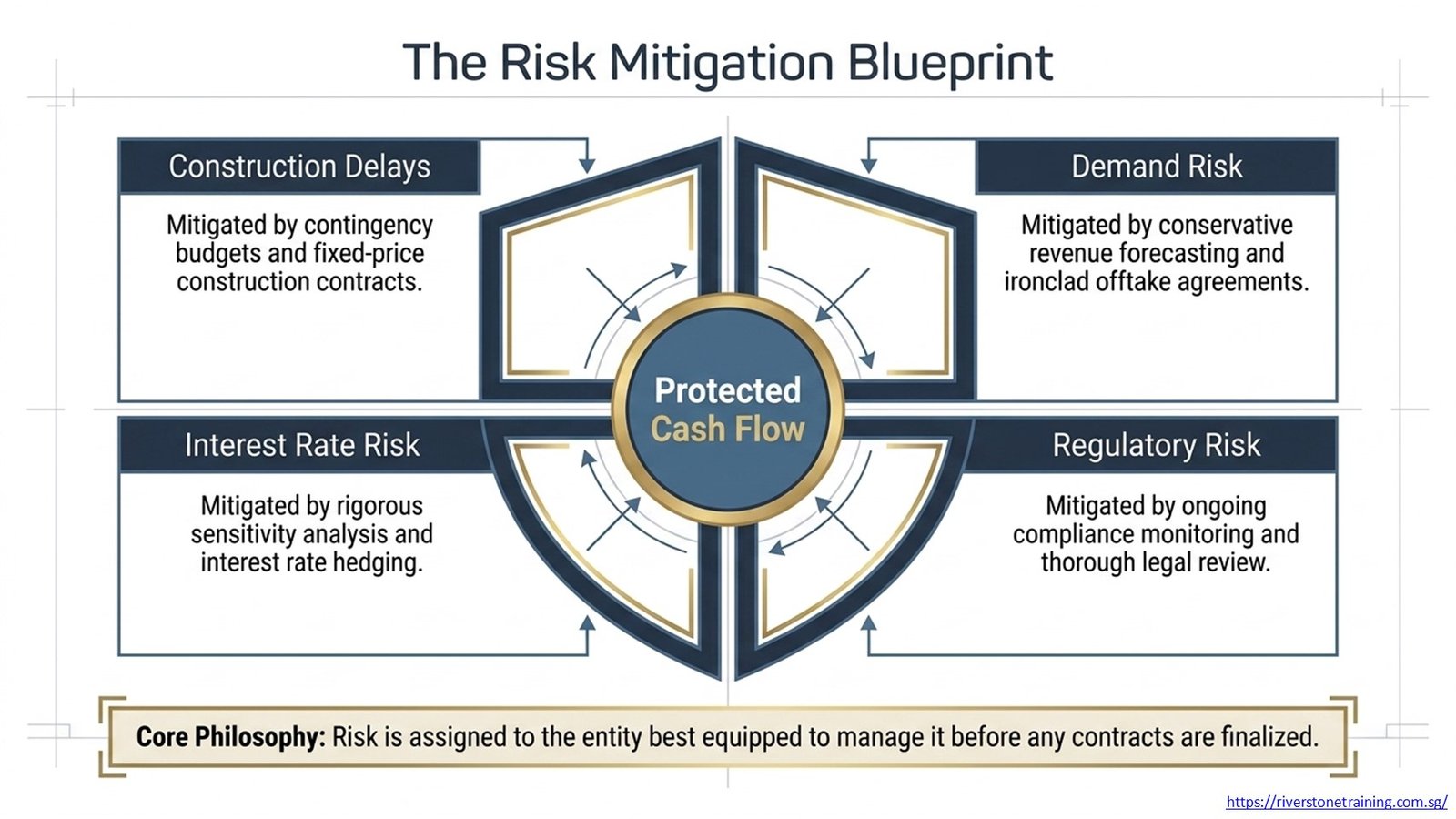
Common infrastructure project risks are: construction delays, uncertainty of demand, interest rate fluctuations, changes in regulations, etc., and each of these can have a material impact on the project returns if not managed. Financial models can be used to quantify these risks, and contractual and financing structures are used to mitigate these risks.
A reasonable risk mitigation approach is usually to use conservative modelling assumptions and contract safeguards, such as fixed-price construction contracts or hedging. The following table summarizes some of the infrastructure risks and some of the common mitigation strategies found in project finance transactions.
| Risk | Mitigation Strategy |
| Construction Delays | Contingency budgets and fixed-price construction contracts |
| Demand Risk | Conservative revenue forecasting and offtake agreements |
| Interest Rate Risk | Sensitivity analysis and interest rate hedging |
| Regulatory Risk | Ongoing compliance monitoring and legal review |
Summary: Key Takeaways for Infrastructure Investment Decisions
The fusion of cash flow modelling, financing structuring and risk analysis under one roof in project finance modelling for infrastructure. The key stages and skills addressed in this article are summarised in the table below.
| Focus Area | Role in Investment Decisions |
| Cash Flow Forecasting | Establishes the financial foundation for all analysis |
| Financing Structure | Determines the debt and equity mix supporting the project |
| Risk and Scenario Analysis | Tests resilience of returns under adverse conditions |
| Financial Metrics (NPV, IRR, DSCR, LLCR) | Provide standardized measures for comparison |
| Professional Training | Builds job-ready modeling and investment judgment skills |
Conclusion
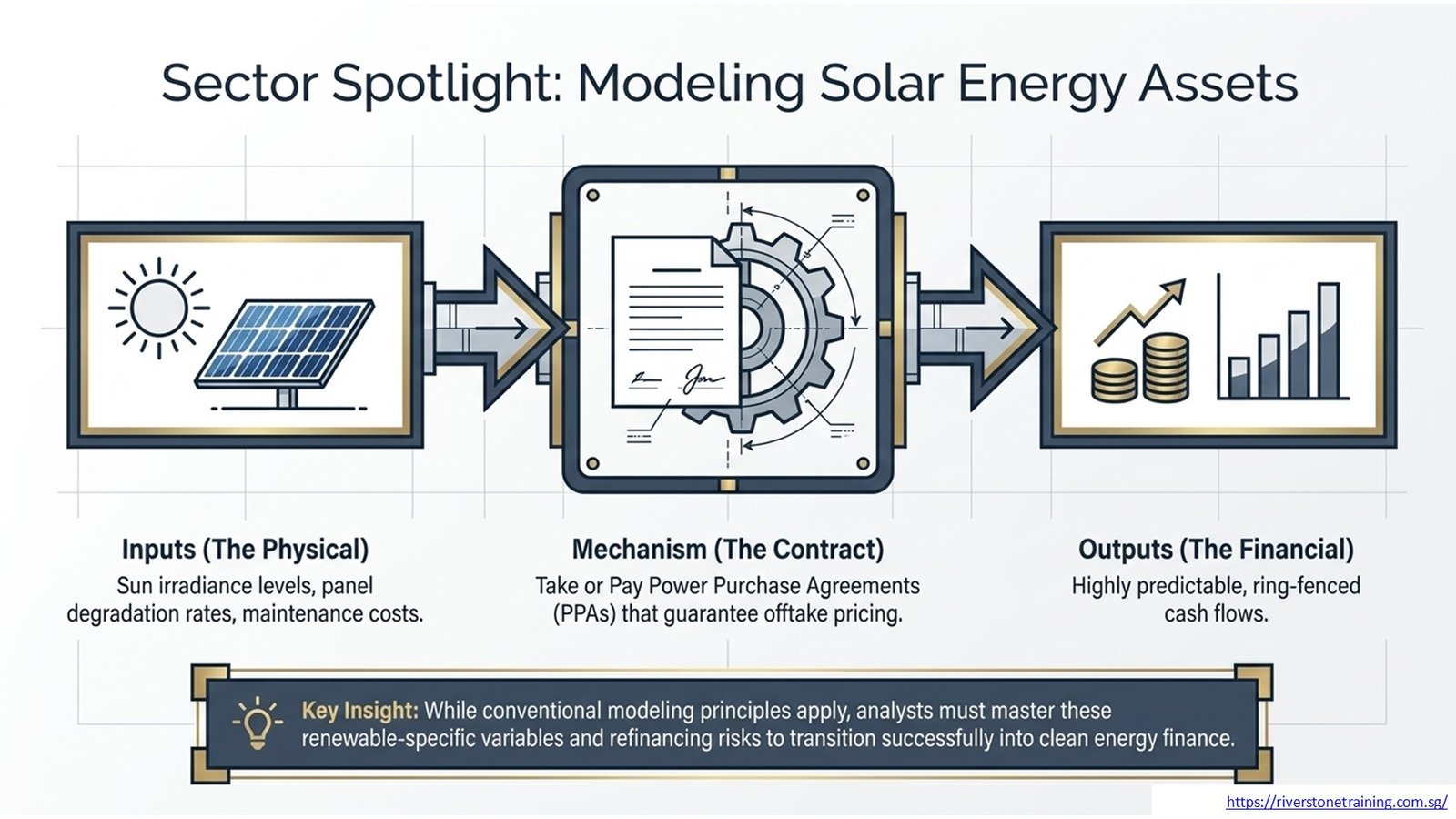
The purpose of project finance models is to provide a clear, actionable picture of the long-term financial viability of an infrastructure investment through the construction budget, revenue projections, and financing conditions. The ability to estimate cash flow accurately, undertake disciplined financing analysis, and analyse and quantify risk are all part of the decision to determine whether an infrastructure project is bankable and whether or not it is worth pursuing.
Project finance modeling is a valuable skill for infrastructure, helping professionals take informed decisions on big investments, and project finance modeling of solar energy demonstrates the application of the same skills to renewable energy projects and their unique financing models and risk factors. To enhance readers’ capabilities, they are recommended to develop their skills through structured training and infrastructure case studies.